

Why the Right Child Car Seat Matters
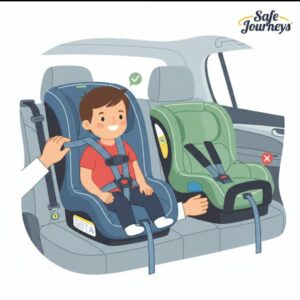
The Science of Safety: How Car Seats Work
To understand why a child car seat is necessary, we must look at the physics of a collision. When a car traveling at 35 mph stops abruptly, everything inside it continues to move at 35 mph until something stops it. In a child, whose bones are still developing and whose head is disproportionately large compared to their body, these forces can be catastrophic.
Energy Absorption: Modern seats are designed with EPS or EPP foam (similar to bicycle helmets) that compresses during an impact, slowing down the child’s body more gradually. This “ride-down” time is crucial in preventing internal injuries.
1. The Four Major Stages of Car Seat Progression
Stage 1: Rear-Facing Only (Infant Seats)
Infant car seats are designed exclusively for the youngest passengers. They feature a handle for portability and a base that remains installed in the vehicle.
Why Rear-Facing? In a frontal collision, the most common type of crash, a rear-facing seat cradles the child’s entire back, neck, and head, distributing the force across the seat shell rather than the child’s body.
Stage 2: Convertible Seats (The Transition Phase)
Convertible seats are the most economical choice. They can be used rear-facing for toddlers (up to 40-50 lbs in many 2025 models) and then turned forward-facing.
Expert Tip: The American Academy of Pediatrics (AAP) recommends children remain rear-facing until they reach the maximum weight or height allowed by their seat manufacturer.
Stage 3: Forward-Facing with Harness
Once the rear-facing limits are met, the child moves to a forward-facing seat with a five-point harness. This stage typically lasts until the child is 5 to 7 years old. The harness keeps the child centered in the seat and prevents them from being ejected during a roll-over.
Stage 4: Booster Seats
The final stage before the vehicle seat belt alone. Boosters raise the child so that the adult seat belt fits properly across the lap (pelvis) and shoulder (collarbone). Without a booster, a seat belt often rests on the neck and stomach, which can cause “seat belt syndrome” in a crash.
2. Top-Rated Child Car Seats of 2025: A Comparative Analysis
| Brand & Model | Type | Best For | Unique Innovation |
|---|---|---|---|
| Graco 4Ever DLX | All-in-One | Longevity | RapidRemove cover for easy cleaning. |
| Britax One4Life | Convertible | Safety/Ease of Use | ClickTight door for 10-second installation. |
| Nuna RAVA | Convertible | Luxury/Legroom | Advanced flame-retardant-free fabrics. |
| Evenflo Revolve360 | Rotational | Accessibility | One-time installation for all modes. |
| Clek Foonf | Convertible | Narrow Spaces | REACT energy management system (Magnesium frame). |
3. The Installation Masterclass
A child car seat is only as good as its installation. Here is how to master the two primary methods.
Method A: The LATCH System
LATCH was introduced to simplify installation, but it has a weight limit. In 2025, most vehicles and seats have a combined limit of 65 pounds.
- Identify: Find the “anchor” symbols on your car seat.
- Attach: Secure the lower connectors.
- Tether: Always use the top tether for forward-facing seats to reduce head excursion.
Method B: The Seat Belt Path
As children get heavier, the seat belt becomes the safest way to secure the seat.
- Locking the Retractor: Most cars after 1996 have a switchable retractor. Pull the belt all the way out to engage “Automatic Locking Mode.”
- The Belt Path: Ensure you are using the correct path (rear-facing and forward-facing paths are different).
4. Maintenance, Recalls, and Expirations
Many parents don’t realize that a child car seat has an expiration date. Typically, this ranges from 6 to 10 years.
Why?
- Plastic Fatigue: Extreme temperature changes in a car (freezing winters, sweltering summers) cause the plastic to become brittle.
- Regulation Changes: Safety standards improve, and older seats may not meet current life-saving requirements.
- Missing Parts: Over years, manuals and adjustment clips often go missing.
Registration is Key
Always mail in the registration card or register your seat online. If there is a safety recall, the manufacturer is legally obligated to notify you and provide a fix or replacement.
5. The Ultimate 10-Point Car Seat Safety Checklist
- Is the seat appropriate for the child’s height and weight?
- Is the seat rear-facing as long as possible?
- Is the inch test passed (less than 1 inch of movement)?
- Are the harness straps at the correct height (at or below shoulders for rear-facing; at or above for forward-facing)?
- Is the chest clip at armpit level?
- Did you perform the pinch test on the harness webbing?
- Is the top tether secure (for forward-facing)?
- Is the seat unexpired and never been in a crash?
- Is the vehicle’s airbag turned off (for front-seat installs, though the back seat is always safer)?
- Has the installation been verified by a CPST?
6. Common Mistakes to Avoid
Even well-meaning parents make these frequent errors:
- Puffy Coats: Thick winter coats create a gap between the child and the harness. In a crash, the coat compresses, leaving the harness too loose. Use a blanket over the harness instead.
- Aftermarket Accessories: Head pillows or strap covers that didn’t come with the seat are not crash-tested and can be dangerous.
- Incorrect Angle: If a rear-facing seat is too upright, a newborn’s head can flop forward, potentially closing their airway.
Final Thoughts
The journey of parenthood is filled with learning curves, and mastering the child car seat is one of the most rewarding. By choosing a high-quality model, staying diligent about installation, and following the “rear-facing as long as possible” rule, you are providing your child with a shield that saves lives.
Remember, the “best” car seat isn’t necessarily the most expensive one—it’s the one that fits your child, fits your car, and is used correctly every single time you buckle up.