
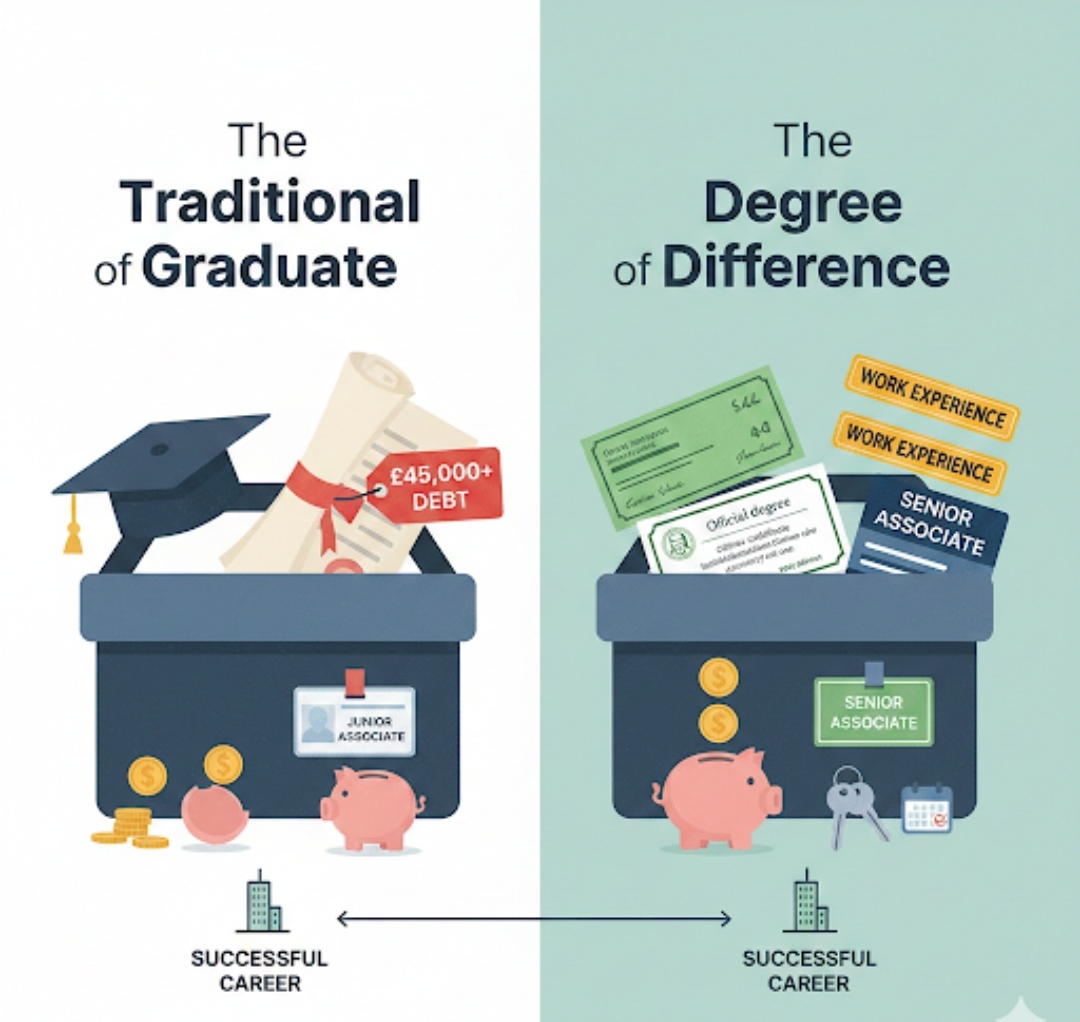
An in-depth analysis of the shifting educational landscape where vocational prestige meets financial pragmatism.
The movement is being led by Gen Z and the earliest members of Gen Alpha, cohorts characterized by their hyper-awareness of debt and a demand for immediate ROI (Return on Investment). In this landscape, students choosing apprenticeships to avoid lifelong debt has become more than a trend—it is a sophisticated economic rebellion.
Read too: Why U.S. Students Are Struggling in Math: A 2025 Comprehensive Analysis

1. The Math of Modern Education: 2026 Economic Data
To understand why students are fleeing traditional higher education, one must look at the brutal arithmetic of student finance in 2026. Tuition fees in the UK have reached an average of £9,750 per annum, but that is only the tip of the iceberg. When interest rates on student loans are factored in—which have seen periodic adjustments to match inflationary pressures—the “cost of entry” into the professional world is staggering.
By contrast, a degree-level apprentice starts their career with a salary typically ranging between £22,000 and £32,000. Over a four-year period, while a university student has “spent” nearly £50,000, an apprentice has “earned” over £100,000. This £150,000 swing in net worth by age 22 is an advantage that few can afford to ignore.
2. The Evolution of Apprenticeship Prestige
For years, apprenticeships suffered from a branding problem, often viewed as a “second-best” option for those who weren’t “academic.” In 2026, that stigma has been completely dismantled. The introduction of Level 6 and Level 7 Degree Apprenticeships has bridged the gap between vocational training and academic rigor.
The Corporate Shift
Major global players—including Google, Deloitte, Rolls-Royce, and AstraZeneca—have expanded their apprenticeship intakes by 40% this year. These firms have realized that the traditional university model often fails to keep pace with the rapid technological advancements in AI and green energy. By training students in-house, they create a workforce that is “future-ready” from day one.
“We are looking for agility, not just a certificate. The students choosing apprenticeships to avoid lifelong debt are often the most motivated, practical, and resilient candidates we see. They aren’t just escaping debt; they are gaining a four-year head start on their peers.”
— Chief Talent Officer, Global Tech Firm.
3. Comparative Analysis: University vs. Apprenticeship
The following table outlines the current 2026 metrics for a standard three-to-four-year educational cycle. This data reflects the “total value” proposition that students are now using to make their decisions.
| Criteria | Standard University Route | Degree Apprenticeship Route |
|---|---|---|
| Upfront Tuition Cost | £29,000 – £38,000 | £0 (Employer Funded) |
| Average Living Debt | £15,000 – £22,000 | £0 (Self-funded through salary) |
| Career Start Date | Post-graduation (Age 21-22) | Day One (Age 18) |
| Guaranteed Employment | No | 92% Retention Rate |
| Mental Health Impact | High “Debt Stress” | Financial Independence |
| Reference Title | The Legacy Pathway | Students Choosing Apprenticeships to Avoid Lifelong Debt |
4. Psychological and Social Implications of Early Debt
One of the most under-discussed aspects of the 2026 education crisis is the psychological toll of “debt-weight.” Young adults entering their 20s with £50,000 in debt are delaying major life milestones. Recent sociological studies indicate that graduates are now 30% less likely to apply for a first mortgage before age 30 compared to their apprenticeship counterparts.
Apprentices, by contrast, are experiencing a “velocity of adulthood.” With a steady income starting at 18, many are able to begin pension contributions and even property ownership while their peers are still sitting in lecture halls. This has created a new social class: the Debt-Free Professional.
5. Sector Focus: Where the Growth Is
In 2026, certain industries have become the “gold standard” for apprenticeship seekers:
- Sustainable Engineering: As the UK moves toward Net Zero 2030, apprentices in wind, solar, and nuclear energy are seeing the highest starting salaries in the vocational sector.
- Cybersecurity & AI: With the 2026 AI Ethics Act, thousands of new roles have been created for “Human-AI Integrators,” a role almost exclusively taught through practical apprenticeship units.
- Legal & Financial Services: The “Solicitor Apprenticeship” has become the preferred route for many top-tier law firms, allowing students to qualify as lawyers without the £20,000+ cost of a Law Masters or SQE prep courses.
6. The Global Context: Is the UK Alone?
While this article focuses on the UK, the “Students choosing apprenticeships to avoid lifelong debt” movement is a global phenomenon. In the United States, the “Apprenticeship Ambassador Initiative” has seen a 300% increase in federal funding. Germany’s “Dual Education” system is being exported to emerging markets in Southeast Asia as the definitive model for economic stability.
7. Conclusion: The Final Verdict for 2026
The era of the “Generalist Degree” is ending. In its place is a more surgical, pragmatic approach to education. Students are no longer viewing education as a “rite of passage” but as a capital investment. By choosing apprenticeships, they are opting out of a broken financial system and into a model that prizes competency, solvency, and real-world impact.
The message for the Class of 2026 is clear: Your worth is not defined by the size of your student loan, but by the depth of your skill set. Those choosing apprenticeships to avoid lifelong debt are not just saving money—they are reclaiming their futures.