

By Editorial Staff | Updated January 12, 2026
Greenland is no longer a peripheral player in the global market. In 2026, it represents the final frontier of mineral exploration. With nearly 80% of its landmass covered by the Greenland Ice Sheet, the retreating ice—while a climatic tragedy—has revealed geological formations that are billions of years old, containing concentrations of metals and minerals found nowhere else on Earth. This article explores the staggering breadth of Greenland’s natural resources, from the minerals powering our smartphones to the clean energy potential of its glacial runoff.
1. The Rare Earth Revolution
Perhaps the most significant answer to What natural resources does Greenland have lies in its Rare Earth Elements (REEs). As of 2026, the European Union and the United States have classified REEs as “top-tier critical assets” due to their necessity in high-tech defense systems and green energy technologies.
The Kvanefjeld and Tanbreez Deposits
Located in the Ilímaussaq intrusive complex in South Greenland, these two deposits are global anomalies. Kvanefjeld alone is estimated to contain one of the world’s largest multi-element deposits of zinc, uranium, and rare earths. While the political debate surrounding uranium mining has been fierce, the sheer volume of Neodymium, Praseodymium, and Terbium available here is enough to supply the global EV market for decades.
Beyond the Magnets
It isn’t just about magnets. Greenland’s REE deposits are unique because they are “heavy” rare earths, which are significantly rarer and more valuable than the “light” rare earths commonly found in other regions. These elements are the secret ingredients in everything from fiber-optic cables to the guidance systems of modern aerospace technology.
2. Base and Precious Metals: The Bedrock of Industry
While rare earths grab the headlines, Greenland’s inventory of base metals is what will build the physical infrastructure of the future. The island’s craton—a stable block of the earth’s crust—is similar to the mineral-rich regions of Northern Canada and Scandinavia.
Iron Ore: The Isua Project
In the Isukasia region, the Isua Greenstone Belt contains a massive iron ore deposit. What makes this resource particularly valuable in 2026 is its purity. As the steel industry moves toward “Green Steel” production, the high-grade magnetite found in Greenland requires less energy to process, significantly lowering the carbon footprint of the final product.
Zinc, Lead, and Copper
Historically, the Black Angel mine at Maarmorilik proved that mining in the Arctic was not only possible but highly profitable. In 2026, new exploration in the Citronen Fjord in Northern Greenland has revealed one of the world’s largest undeveloped zinc-lead deposits. These metals are critical for galvanizing steel and for the massive expansion of the global electrical grid.
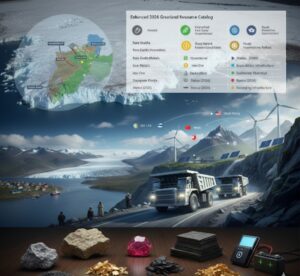
Enhanced 2026 Greenland Resource Catalog
This table summarizes the core assets currently under development or exploration across the island.
| Resource Type | Specific Elements | Primary Global Use | Estimated Value / Reserve Scale |
|---|---|---|---|
| Rare Earths | Neodymium, Praseodymium, Yttrium | EV Motors, Wind Turbines | Global Tier-1 (Top 25% of world supply) |
| Energy Minerals | Uranium (Controversial), Graphite | Nuclear Power, Battery Anodes | Massive (subject to local regulation) |
| Base Metals | Zinc, Lead, Copper, Iron | Construction, Power Grids | Multi-billion ton potential |
| Precious Metals | Gold, Platinum, Palladium | Electronics, Investment | High-grade (15g/t+ in some sites) |
| Gemstones | Rubies, Pink Sapphires | Luxury Jewelry | Consistent commercial export |
| Future Energy | Hydropower, Green Hydrogen | Clean Fuel, Grid Stability | Estimated 5GW+ Potential |
3. Energy Resources: From Hydropower to Hydrogen
When asking What natural resources does Greenland have, one must look beyond the solid ground. Greenland’s most abundant resource is water, and in a world thirsty for carbon-free energy, this is a literal gold mine.
The Hydropower Paradigm
Greenland already generates a significant portion of its domestic electricity from hydropower. However, the potential for expansion is enormous. Large-scale glacial meltwater can be harnessed to power massive industrial operations, making Greenland one of the few places on earth where “Green Mining” (mining powered entirely by renewables) is a reality.
Green Hydrogen Export
In 2026, the concept of Greenland as an energy exporter has taken hold. By using excess hydropower to perform electrolysis, Greenland can produce Green Hydrogen and Ammonia. These fuels can then be shipped to Europe and North America, positioning the island as the “Norway of the Arctic” in terms of energy influence.
4. The Human and Environmental Cost
The exploitation of Greenland’s natural resources is not without its hurdles. The Greenlandic government, the Naalakkersuisut, faces the delicate task of balancing economic independence from Denmark with the preservation of the Inuit way of life.
Mining projects in Greenland are subject to some of the world’s strictest environmental impact assessments (EIAs). The “Social License to Operate” is a mandatory requirement, ensuring that local communities benefit from jobs, infrastructure, and education. This human-centric approach is what sets Greenland apart from other resource-rich emerging markets.
5. Geopolitics: The Battle for the North
The question of What natural resources does Greenland have has naturally invited international competition. The “Great Power Competition” between the US, China, and the EU is playing out in the fjords of Greenland.
- The US Interest: Focuses on national security and preventing a Chinese monopoly on REEs.
- The Chinese Interest: Primarily investment-led, through stakes in various mining consortia.
- The EU Interest: Centered on the “Green Deal” and securing a “near-shore” supply of critical minerals.
Conclusion: The Future is Greenlandic
In summary, the answer to What natural resources does Greenland have is as complex as it is vast. From the depths of the Kvanefjeld rare earth deposits to the rushing waters of its hydropower plants, Greenland is an island of immense strategic value. As we move further into 2026 and beyond, the responsible development of these resources will not only dictate the wealth of the Greenlandic people but will also determine the success of the global energy transition.
The Arctic is no longer a frozen wasteland; it is the engine room of the future. For investors, environmentalists, and global citizens alike, Greenland is the most important story of our time.