
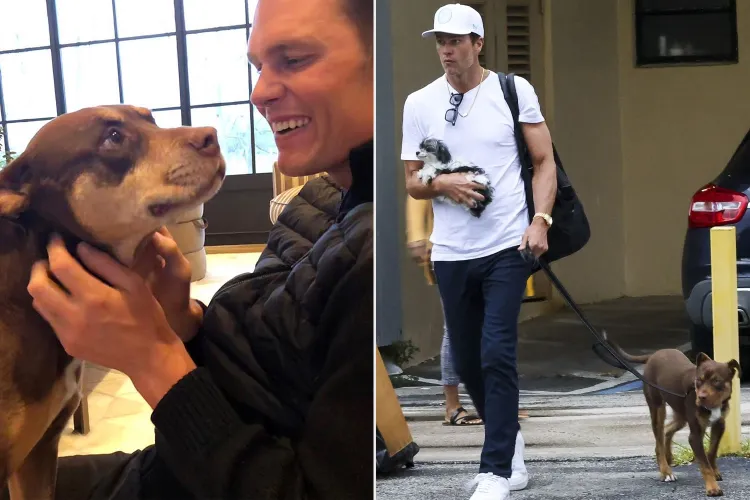
When seven-time Super Bowl champion Tom Brady revealed that his new dog was a clone of his late pet, fans were stunned. The story, trending under the tag # Clone Dog Tom Brady, blends celebrity life, cutting-edge biotechnology, emotional bonds, and ethical questions about cloning.
Brady has long been known for pushing boundaries in performance, nutrition, and longevity. Now, he’s at the frontier of another controversial domain — pet cloning. This is the full story of how it happened, the science behind it, and the questions it raises about love, technology, and what makes life unique.

The Backstory: Tom Brady and His Beloved Dog Lua
Tom Brady and his former wife, Gisele Bündchen, once shared a pit-bull mix named Lua. The dog was a fixture in family photos, often seen accompanying them on vacations or around their homes in Massachusetts and Florida. Lua passed away in December 2023, leaving a gap in the Brady family’s life.
Before Lua died, her DNA had been preserved through a simple blood draw. That sample would later become the foundation for something extraordinary: the creation of Junie, Lua’s genetic twin.
The Revelation: Meet Junie, the Cloned Dog
In early November 2025, Tom Brady announced that his family had a new puppy, Junie — and that she was a clone of Lua. He explained that the cloning was performed using non-invasive techniques developed by Colossal Biosciences, a Texas-based biotech company in which Brady himself is an investor.
“A few years ago, I worked with Colossal and leveraged their non-invasive cloning technology through a simple blood draw of our family’s elderly dog before she passed,” Brady wrote in a statement. “The company gave my family a second chance with a clone of our beloved dog.”
The news spread quickly. While some fans were moved by Brady’s emotional story, others were unsettled by the ethics of cloning a pet.
The Company Behind the Cloning
Colossal Biosciences, headquartered in Dallas, Texas, is best known for its ambitious goal of using genetic technology to “de-extinct” animals such as the woolly mammoth and the Tasmanian tiger. In 2025, the company acquired Viagen Pets & Equine, one of the world’s few commercial pet-cloning services.
Viagen has previously cloned pets for several celebrities, including Paris Hilton and Barbra Streisand. The cost of cloning a dog through Viagen typically ranges from $50,000 to $85,000.
By connecting with Colossal Biosciences, Brady’s cloning story gained a symbolic weight: a sports legend and a cutting-edge biotech company meeting at the crossroads of love, memory, and science.
What Pet Cloning Actually Is
Cloning is the process of creating a new organism that shares the same DNA as another living being. It does not mean creating a perfect copy — especially in terms of behavior or personality.
The process, known as somatic cell nuclear transfer (SCNT), involves:
- Collecting DNA from the original animal (in this case, Lua).
- Transferring the nucleus of one of those cells into an egg cell whose nucleus has been removed.
- Stimulating the egg to divide and develop into an embryo.
- Implanting the embryo into a surrogate mother dog, who then gives birth to a genetically identical puppy.
The resulting animal shares the same DNA as the original, but its upbringing, environment, and experiences make it unique.
Science vs. Sentiment: Why People Clone Pets
To understand why someone would clone a pet, it helps to think about the emotional bond between humans and animals. For many, pets are not possessions — they are family members. Losing one can be as painful as losing a loved one.
For Brady, Lua was reportedly a constant companion through his playing career and retirement. The idea of “continuing” that relationship, even in some genetic sense, carried deep emotional meaning.
Cloning promises what grief cannot: a form of continuity. You can’t bring back the same animal, but you can preserve its DNA, its appearance, perhaps even its quirks.
However, scientists and ethicists emphasize that cloning a dog does not recreate the same personality. A clone is genetically the same but experientially new — a living being with its own life to lead.
The Ethical Debate Around Pet Cloning
The story of # Clone Dog Tom Brady has reignited debates about whether cloning pets is right or wrong. The arguments fall into a few key categories.
1. Animal Welfare
Cloning is a complicated process with uncertain success rates. For every successful clone, several embryos or surrogates may fail. Animal-rights advocates worry about the suffering of the surrogate mothers and the cloned pups who may have health complications.
2. Grief and Acceptance
Some psychologists argue that cloning a pet may interfere with the natural process of grieving. Instead of accepting loss, owners may chase an illusion of restoration — expecting the new dog to behave exactly like the old one.
3. Exclusivity and Wealth
At tens of thousands of dollars per procedure, pet cloning is accessible only to the ultra-rich. Critics say it reflects social inequality — when millions of shelter dogs need homes, cloning one’s own becomes a luxury few can justify.
4. The Question of Identity
Even if a clone shares the same DNA, is it the same being? Most ethicists say no. As one expert put it:
“Everything that matters about personality and individuality is not written in the genes.”
The cloned pet may look identical, but it is a new consciousness — not a resurrected soul.
Technology at the Edge of Science
While pet cloning has existed for about two decades, the technology is improving rapidly. Success rates are rising, procedures are becoming less invasive, and DNA preservation can now be done with a simple blood sample.
Colossal Biosciences, Brady’s partner in this story, aims to push cloning even further. The company uses gene-editing tools like CRISPR and cell reprogramming to study extinct species. It recently announced the successful cloning of dire-wolf embryos — bringing science fiction closer to reality.
For Brady, who has always been fascinated by longevity and performance optimization, this partnership reflects a consistent theme: the pursuit of extending life — whether human or animal.
Why the Story Captivated the World
Several forces combined to make # Clone Dog Tom Brady a global trend.
The Celebrity Factor
Tom Brady’s fame ensures that anything he does, from diet choices to business ventures, draws attention. The idea that a world-famous athlete would clone his dog immediately sparked fascination.
The Emotional Hook
Losing a pet is one of the most universal human experiences. The thought of bringing a pet back — even partially — resonates deeply with pet owners everywhere.
The Technological Marvel
Cloning is still exotic to most people. Combining it with a familiar story of love and loss made the topic relatable and extraordinary at once.
The Cultural Conversation
The Brady case forces society to ask questions that sound philosophical but are increasingly practical:
- How far should we go to preserve life?
- Is cloning a form of love, or a refusal to let go?
- When does technology cross into playing God?
Read too : High Calorie Dog Food: A Comprehensive Guide For Canine Nutrition
How Junie Is Doing Now
According to recent reports, Junie — the cloned dog — is healthy, energetic, and living with Brady’s family. Those close to the family describe her as affectionate and playful, much like Lua once was.
Observers note that Junie resembles Lua almost perfectly: same coat, same face, same curious eyes. Yet those who understand cloning remind us that Junie is not Lua’s reincarnation. She is a separate being, deserving her own identity and love.
Broader Implications for Pet Ownership
The cloning of Lua raises questions far beyond one celebrity story.
Could Cloning Become Common?
As technology improves and costs potentially fall, cloning could become more mainstream. Some foresee a future where veterinarians offer DNA-preservation services as standard, allowing pet owners the option to clone later.
Will It Change How We Love Pets?
If cloning becomes normalized, our understanding of companionship, loss, and attachment may shift. Would owners treat pets differently if they believe they can “get them back”?
Conservation and Science
Some scientists see pet cloning as a stepping-stone to more ambitious goals: cloning endangered animals or reviving extinct ones. Technologies pioneered in pet cloning can also be used for genetic conservation, preserving biodiversity.
Criticism and Controversy
Not everyone applauds Tom Brady’s choice. Animal-welfare groups, ethicists, and even some fans have voiced concerns:
- Commercialization of Grief: Critics say cloning companies exploit emotional vulnerability for profit.
- False Expectations: Owners might project their memories onto the clone, expecting identical behavior.
- Animal Rights: The cloning process involves surrogate animals, and its overall welfare record remains debated.
Still, supporters argue that if the process is humane and scientifically responsible, cloning can offer comfort and innovation simultaneously.
Timeline of Events
| Date | Event |
|---|---|
| Before 2023 | Lua’s DNA is preserved through blood sampling. |
| December 2023 | Lua passes away, leaving Brady’s family grieving. |
| 2024 | Colossal Biosciences acquires Viagen Pets & Equine. |
| November 4, 2025 | Brady reveals Junie, a clone of Lua. |
| 2025 onward | Global discussion about cloning ethics and technology intensifies. |
Pet Cloning Around the World
Cloning pets is legal in the United States and South Korea but restricted or banned in many European countries.
- United States: Viagen is the leading service provider.
- South Korea: The Sooam Biotech Research Foundation pioneered early cloning in dogs.
- Europe: Strict ethical regulations prevent commercial pet cloning.
Despite the controversies, the market for pet cloning is slowly growing. For wealthy pet owners, it represents a way to hold on to something irreplaceable.
Perspectives from Experts
Scientists
Researchers in genetics acknowledge that cloning has legitimate scientific and conservation applications but warn that it’s not emotional resurrection.
“Cloning copies DNA, not memories. You’re making a new animal, not reviving the old one.”
Ethicists
Ethicists emphasize responsibility: if humans choose to clone, they must ensure animal welfare and avoid commodifying life.
Veterinarians
Many veterinarians stress the unpredictability of cloned pets’ health outcomes. Though improvements continue, some clones face developmental issues early in life.
A Reflection on Humanity’s Desire to Defy Loss
Tom Brady’s cloned dog story is more than a celebrity headline — it’s a mirror of humanity’s age-old dream: to conquer mortality.
From myths of eternal life to modern cryogenics, humans have always sought to hold on to what they love. Pet cloning is one more step in that long journey — one that blurs the line between grief, hope, and hubris.
Brady’s decision is both deeply personal and culturally symbolic. It suggests that even the world’s most disciplined athlete, who mastered control over his body and career, cannot control one thing: loss.
The Emotional Core
Beneath the science and controversy lies a simple story of love. Lua was a loyal companion. Her death was a heartbreak. Brady’s choice to clone her wasn’t just about technology — it was about memory, attachment, and the human need to keep love alive in whatever form possible.
Whether you see it as beautiful or unsettling, the bond between people and their pets is undeniably powerful. Cloning, for better or worse, offers a new way to express that bond.
The Future of Cloning and Compassion
As technology evolves, society will continue to debate cloning’s role. Should we use it to bring back beloved pets? To revive extinct species? To engineer better genetics?
Each advance forces us to define where science should serve emotion — and where it should stop.
For now, Junie lives, plays, and wags her tail, unaware of the controversy she represents. To her, life is simple. And perhaps that’s the reminder we all need: whether cloned or not, every creature deserves to live and be loved for who they are.
Closing Thoughts
The story of # Clone Dog Tom Brady isn’t just about fame or technology. It’s about how far love and grief can drive us — and how science offers both comfort and complication.
Tom Brady’s decision bridges two worlds: the emotional and the scientific. It challenges us to ask not whether we can clone life, but whether we should.
For now, one thing is clear — in the age of genetic miracles, even the world’s greatest quarterback has found a new way to redefine “the comeback.”