

The Biomimetic Revolution Shrinking the Future of Spatial Computing
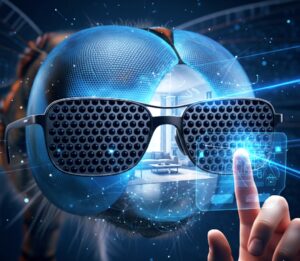
The Failure of the Single-Lens Paradigm
Human vision is amazing, but for a wearable computer, it is a nightmare to replicate. Traditional cameras are modeled after the vertebrate eye: a single large aperture, a lens with specific focal length, and a flat sensor. In a VR headset, this creates a “stack” of hardware that forces the device to protrude several inches from the face. This leverage effect turns even a 500g headset into a significant burden on the neck muscles after an hour of use.
Furthermore, standard lenses suffer from “barrel distortion” and “chromatic aberration” when forced into wide angles. To fix this, manufacturers add more glass elements, which increases weight—a vicious cycle that has kept VR in the “goggles” category for a decade. By redefining VR design through biomimicry, we are finally breaking this cycle.
The Dragonfly’s Advantage: How Compound Eyes Work
An insect doesn’t have one lens; it has thousands. These individual units, called ommatidia, are clustered together. Each ommatidium captures light from a tiny sliver of the world. The insect’s brain then fuses these thousands of low-resolution inputs into a comprehensive, high-temporal-resolution map of its surroundings.
1. Panoramic Perspective without the Bulk
Because the ommatidia are arranged on a curved surface, an insect can see nearly 360 degrees without moving its head. For VR, this means we can replace four or five separate tracking cameras with a single, wraparound “insect-eye” strip. This reduction in part count leads to sleeker industrial designs and fewer points of failure.
2. The Power of “Infinite Focus”
In a traditional camera, you must move the lens to focus on a nearby object versus a far one. Insect eyes have a “fixed-focus” depth of field that is effectively infinite. In VR tracking, this is a game-changer. Whether a user’s hand is two inches from the headset or ten feet away, these tiny cameras see it with the same sharp clarity, leading to flawless hand-tracking and gesture control.
Impact on Industrial Design: From Goggles to Glasses
When you remove the need for focal depth, you change the “Z-axis” of hardware design. This is where insect-inspired cameras are redefining VR design most visibly. We are moving toward “pancake-flat” sensors that can be hidden behind decorative trim or even integrated into the fabric of a head-strap.
| Design Pillar | Traditional Camera Era | Insect-Eye (ACE) Era |
|---|---|---|
| Form Factor | “Scuba Mask” / Front-heavy | Ultra-thin / “Aviator” Style |
| Thermal Profile | High heat from high-res processing | Low-power motion-edge detection |
| Tracking FoV | Limited (Blind spots under chin/sides) | Full Hemispherical (No blind spots) |
| User Fatigue | High (Neck strain after 45 mins) | Negligible (All-day wearability) |
Technical Mastery: Processing Like a Bee
One might ask: “If we have 5,000 tiny cameras, doesn’t that require 5,000 times the processing power?” The answer lies in the insect’s neural efficiency. Insects don’t process every pixel for color and beauty; they process Optical Flow—the movement of light across the sensor.
Modern VR chipsets are now incorporating “Event-Based Vision” sensors inspired by this. Instead of sending a full image frame 60 times a second, the tiny insect-eye cameras only report changes in light. This reduces the data load by up to 90%, allowing for much smaller batteries and no noisy cooling fans. This efficiency is the hidden engine redefining VR design from the inside out.
The “Invisible” Sensor: A Solution for Social Acceptability
A major hurdle for Augmented Reality (AR) and VR is the “Creep Factor.” People are uncomfortable talking to someone wearing visible camera lenses. Because these biomimetic cameras are so small—often less than a millimeter in diameter—they can be embedded under “IR-transparent” materials. To the observer, you are wearing stylish glasses. To the user, the glasses are seeing and mapping the entire world in high-definition 3D.
Future Applications: Beyond the Living Room
- Surgical Precision: Doctors can use ultra-light headsets that track micro-movements of their hands via insect-eye arrays without the headset shifting during a long procedure.
- Extreme Sports: Imagine a motocross helmet with built-in VR/AR that uses compound-eye sensors to give the rider a “rear-view” overlay without adding weight to the helmet.
- Military HUDs: Low-profile visors that provide 360-degree situational awareness through the “stitching” of thousands of tiny micro-lenses.
Conclusion: The Dawn of the Biomimetic Era
The journey to the ultimate VR headset didn’t require bigger lenses; it required smaller ones—and more of them. By embracing the 400-million-year-old design of the dragonfly, we are finally shedding the “bulky” label that has plagued Virtual Reality since its inception. These tiny cameras inspired by insect eyes are not just a component; they are the catalyst redefining VR design, ensuring that the next generation of digital interaction is as light as air and as clear as nature intended.