
When Science Steps Off the Page
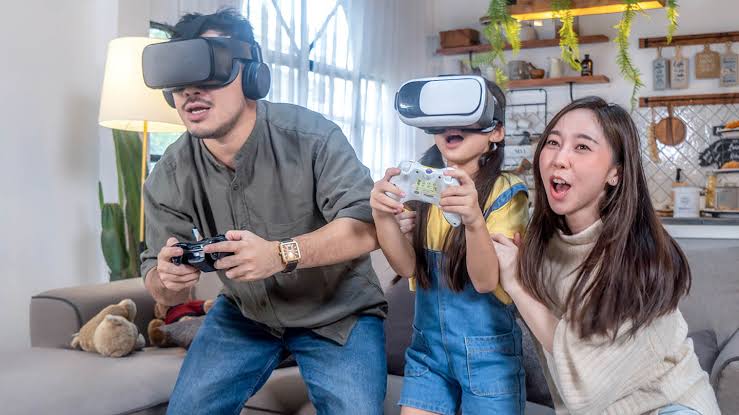
Walk into a modern science classroom today and you might see students wandering through coral reefs, shrinking themselves down to the scale of DNA, or holding the solar system in their hands.
What once lived only in textbooks is now unfolding around them—interactive, vivid, unforgettable.
This is the world of immersive science education, powered by VR headsets, AR overlays, mixed-reality holograms, and AI-driven simulations. And according to emerging research on ScienceDirect, it’s one of the most powerful learning innovations of our time.

A Portal Into Other Worlds
Forget static diagrams and lab manuals. Immersive technology is turning science into an experience—one that students can step into, interact with, and experiment inside.
VR Labs: The Science Field Trip Without Leaving the Room
In VR, a classroom becomes anything: a human bloodstream, the surface of Mars, a chemical reaction chamber. Students can zoom into molecules or walk across tectonic plates. Studies cited by EducationNext show that VR labs boost both confidence and comprehension.
AR: The Textbook That Comes Alive
Open a standard biology book, and—through an AR-enabled device—the heart starts beating, the cells divide, and the nervous system lights up. Diagrams aren’t read; they’re explored.
Mixed Reality: Team Science in 3D
With MR headsets, students gather around a hologram of a hurricane or a protein chain. They manipulate data, test hypotheses, and discover insights together—almost like scientists in a futuristic lab.
Why Immersive Science Works So Well
Science is full of things too small, too big, too fast, too slow, or too dangerous to observe directly. Immersive tech removes these limits.
It Boosts Memory
When students experience science—move through it, touch it, observe it in 3D—they remember it. The brain loves stories, spaces, and movement. Immersive tech delivers all three.
It Makes the Abstract Understandable
Suddenly, electrons don’t feel abstract. Earthquakes aren’t theoretical. Climate models aren’t hypothetical—they unfold visually.
It Gets Students Excited
Gamified goals, hands-on missions, and safe experimentation turn anxious students into eager explorers.
It Levels the Playing Field
With VR labs, any school can deliver high-quality scientific exploration—no multimillion-dollar facilities required.
Where Immersive Tech Is Changing Science the Fastest
Biology Becomes a Journey
Tour the respiratory system, explore coral bleaching, or watch evolution play out. The natural world becomes navigable.
Chemistry Becomes a Show
Molecules dance, electrons spin, and chemical reactions reveal their hidden steps—without the danger.
Physics Becomes a Playground
What if you change gravity? Or reduce friction? VR lets students break physics and learn from the consequences.
Earth & Space Become Reachable
Walk through a rainforest, stand inside a volcano, or fly through the rings of Saturn. Impossible field trips become daily lessons.
Environmental Science Becomes Predictive
AI simulations show the future in real time. Change CO₂ levels and watch climates shift instantly.
The College and Research Labs Already Living in the Future
Universities and researchers are among the fastest adopters:
- Medical schools use VR cadavers and holographic organs.
- Engineering programs rely on virtual prototypes and digital twins.
- Astronomers navigate cosmic structures in 3D.
What used to require specialized labs can now be done in an immersive headset.
AI: The Hidden Engine Behind It All
AI is quietly powering the most advanced immersive experiences:
- Simulations that change instantly with user input
- Personalized learning pathways
- Voice-guided lab assistants
- Data-rich holographic visualizations
AI doesn’t just support immersion—it amplifies it.
The Obstacles Still in the Way
Though transformative, immersive tech faces challenges:
- High hardware costs
- Teacher training requirements
- Uneven content quality
- Occasional VR discomfort
Still, with prices falling and platforms improving, these issues are shrinking fast.
The Future: Science You Can Feel
What’s coming next borders on science fiction:
- AI-built worlds generated from a single command
- Haptic suits that let students feel magnetic fields or fluid dynamics
- Neural interfaces that deliver understanding directly through brain-computer links
Science class is evolving from a room into an entire interactive universe.
Conclusion: Learning That Stays With You
Immersive technology doesn’t just teach science—it lets students experience it. By making the invisible visible and the untouchable safe, it brings curiosity back into learning and gives every student the chance to explore like a real scientist.
Science has never been this alive.
And it’s only the beginning.