

Policy Analysis & Editorial | Winter 2025 Edition
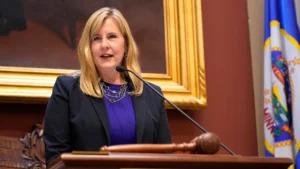
I. The Suburban Roots of a Power Broker
To understand the political DNA of Melissa Hortman, one must look toward the second-ring suburbs of the Twin Cities. Representing Brooklyn Park, Hortman does not hail from the deep-blue bastions of Minneapolis or St. Paul. Her political identity was forged in a district that mirrors the broader American demographic shift: diversifying, economically varied, and pragmatically focused. It is this “suburban sensibility” that has allowed her to bridge the gap between the rural “Farmer-Labor” roots of her party and its modern, progressive urban wing.
Educated as a lawyer, Hortman brought a litigator’s eye for detail to the Capitol. Early in her career, she established herself as a policy wonk with a particular interest in transportation and energy. However, it was her temperament—cool, calculated, and intensely disciplined—that caught the attention of leadership. She understood early that in a chamber of 134 individuals, power is not seized through rhetoric alone, but through the mastery of the rulebook and the building of trust across the caucus.
II. The “Deck of Cards” Moment: A Cultural Shift
Every leader has a defining moment where their internal resolve meets public scrutiny. For Melissa Hortman, that moment occurred in 2017 during a debate on a protest-related bill. When Republican colleagues criticized her for being absent from the floor, she famously responded that she had been in the retiring room speaking with fellow female legislators about the impact of the legislation. She noted, with a sharp edge of transparency, that she was tired of being lectured by men about her presence while they were often found “playing cards” in the back room.
This was more than a viral soundbite. It signaled a shift in the gender dynamics of the Minnesota Capitol. It established Hortman as a leader who would not play by the unspoken rules of a “boys’ club” culture. It galvanized the women in her caucus and signaled to the opposition that the traditional methods of intimidation would no longer yield results. From that point forward, Hortman wasn’t just a member of leadership; she was the face of a new, assertive DFL era.
III. The 2023 Session: A Masterclass in the “Trifecta”
The 2022 election granted Minnesota Democrats a “trifecta”—control of the House, the Senate, and the Governor’s mansion. However, the margins were historically narrow. In the Senate, the DFL held a single-seat majority. In the House, Hortman had to manage a caucus where every single vote was the “deciding” vote. Many analysts predicted a cautious, incremental session. Melissa Hortman had other plans.
What followed was a legislative blitzkrieg that redefined the social contract in Minnesota. Under Hortman’s direction, the House passed:
- Universal School Meals: Ensuring every child, regardless of income, receives breakfast and lunch.
- 100% Clean Energy by 2040: One of the most ambitious climate mandates in the nation.
- Codification of Abortion Rights: Making reproductive healthcare a statutory right in the wake of the Dobbs decision.
- Paid Family and Medical Leave: A massive expansion of the state’s social safety net for workers.
Hortman’s strategy was to “go big and go fast.” She realized that political windows of opportunity are fleeting. By bundling priorities and maintaining strict caucus discipline, she prevented the opposition from picking off moderate members. She turned the House floor into a conveyor belt of policy, often working late into the night to ensure the momentum never stalled.
IV. The Economic Philosophy of Hortmanism
Critics of Melissa Hortman often point to the record-breaking state budget and the utilization of a $17 billion surplus as evidence of fiscal overreach. They argue that the tax increases and spending programs will eventually lead to capital flight. However, Hortman’s editorial defense of these policies is rooted in a modern economic theory often called “middle-out” or “bottom-up” economics.
In her public addresses, Hortman frequently connects the dots between a parent’s ability to find affordable childcare and the state’s overall GDP. She views the state budget not as a static ledger, but as a strategic investment fund. For Hortman, the risk isn’t in spending too much; it’s in failing to address the structural inequities that prevent the workforce from reaching its full potential. This ideological clarity has made her a formidable opponent in budget negotiations, as she rarely cedes ground on the “human” elements of the fiscal plan.
V. Managing the “Big Tent” Caucus
Perhaps the most difficult task for any Speaker is managing the internal contradictions of their own party. The DFL is a “big tent” that includes iron-range miners, suburban professionals, and urban activists. These groups often have clashing priorities, particularly regarding environmental regulations and labor laws.
Melissa Hortman has mastered the art of the “internal trade.” She is known for spending hours in one-on-one meetings with her members, listening to their district-specific concerns and finding ways to weave them into the larger legislative tapestry. She understands that for a rural DFLer to vote for a climate bill, they need to see investments in rural broadband or local infrastructure in return. This transactional brilliance is the glue that has kept the DFL majority intact through some of the most contentious debates in state history.
VI. The Future of Minnesota Leadership
As we look toward the 2026 cycle and beyond, the question of “What’s next for Melissa Hortman?” looms large. Some speculate about a run for the Governor’s mansion or a federal appointment. However, Hortman herself seems uniquely suited to the legislative arena. She is a creature of the House—someone who thrives in the mechanics of bill drafting and the chess match of the floor debate.
Her legacy will likely be defined by the durability of the “Minnesota Model.” If the policies passed under her speakership lead to sustained economic growth and improved quality of life metrics, she will be remembered as the woman who proved that progressive governance is not only possible in the Midwest but preferable. If, however, the state faces a fiscal “reckoning,” she will be the primary target of the inevitable political pendulum swing.
Conclusion: The Gavel and the Legacy
In the final analysis, Melissa Hortman represents a new breed of legislative leader. She is less interested in the performative aspects of the speakership and more interested in the raw output of the institution. She has taken a state that was often seen as “Minnesota Nice”—polite but stagnant—and turned it into a laboratory of bold experimentation.
The gavel in Hortman’s hand is not just a tool for order; it is a tool for carving out a new vision of the American Midwest. As long as she holds that gavel, Minnesota will remain at the forefront of the national conversation, proving that even in a divided country, a determined leader can still build a bridge to the future.