
More Than Just a Quarterback
In the pantheon of NFL legends, few figures command as much respect across different eras as Troy Aikman. To the fans of the 1990s, he was the steely-eyed general of the Dallas Cowboys, the man who delivered three Super Bowl trophies to the “Star” in Texas. To the younger generation of fans, he is the authoritative, no-nonsense voice heard every Monday night on ESPN. His journey is one of immense pressure, physical sacrifice, and an unwavering commitment to excellence.
Standing 6’4″ with a classic over-the-top delivery, Aikman embodied the “Pro-Style” quarterback. While his career statistics are often debated against the inflated numbers of the modern “pass-happy” NFL, his value is measured in championships, accuracy, and his ability to perform when the stakes were highest. This article explores the journey of a man who didn’t just play the game; he mastered its many dimensions.
Read too: American Heritage Football: A Comprehensive Guide

Article Contents
- More Than Just a Quarterback
- Early Life: The Oklahoma-California Connection
- The UCLA Renaissance: Developing the Golden Arm
- 1989 NFL Draft: A Franchise-Altering Moment
- The 1990s Dynasty: “The Triplets” Era
- The 49ers Rivalry: Battle for the Decade
- The Mechanics of Excellence: Why Aikman was Elite
- Transition to Media: Defining the Television Era
- Business & Philanthropy: The Eight Beer Legacy
- Detailed FAQ on Troy Aikman
Introduction: More Than Just a Quarterback
In the pantheon of NFL legends, few figures command as much respect across different eras as Troy Aikman. To the fans of the 1990s, he was the steely-eyed general of the Dallas Cowboys, the man who delivered three Super Bowl trophies to the “Star” in Texas. To the younger generation of fans, he is the authoritative, no-nonsense voice heard every Monday night on ESPN. His journey is one of immense pressure, physical sacrifice, and an unwavering commitment to excellence.
Standing 6’4″ with a classic over-the-top delivery, Aikman embodied the “Pro-Style” quarterback. While his career statistics are often debated against the inflated numbers of the modern “pass-happy” NFL, his value is measured in championships, accuracy, and his ability to perform when the stakes were highest. This article explores the 1,500-word journey of a man who didn’t just play the game; he mastered its many dimensions.
Early Life: The Oklahoma-California Connection
Troy Kenneth Aikman was born on November 21, 1966. While he was born in West Covina, California, the grit that defined his playing style was cultivated in Henryetta, Oklahoma. Moving to the small Oklahoma town at age 12, Aikman was immersed in a culture where football was more than a sport—it was a way of life.
At Henryetta High School, Aikman was a multi-sport phenom. He wasn’t just a quarterback; he was an All-State baseball player with MLB potential. However, the gridiron called. His recruitment was a national story, eventually leading him to the University of Oklahoma to play for Barry Switzer. It was a clash of styles from the start: Aikman was a pure pocket passer, while Switzer’s “Wishbone” offense was a run-heavy system. A broken leg in a game against Miami (FL) eventually led to the rise of Jamelle Holieway and Aikman’s decision to transfer—a move that would change the course of his life.
The UCLA Renaissance: Developing the Golden Arm
Transferring to UCLA was the catalyst for Troy Aikman’s professional prospects. Under Coach Terry Donahue, Aikman found a pro-style system that allowed him to showcase his elite arm talent and decision-making. In his two seasons as a starter for the Bruins (1987-1988), he led the team to a 20-4 record.
In 1988, Aikman’s senior season was a masterclass in efficiency. He threw for 2,771 yards and 24 touchdowns, winning the Davey O’Brien Award and earning consensus All-American honors. Most importantly, he proved he could handle the bright lights of a major media market in Los Angeles, a skill that would prove vital when he was drafted into the “fishbowl” of Dallas, Texas.
1989 NFL Draft: A Franchise-Altering Moment
When Jerry Jones purchased the Dallas Cowboys in 1989 and fired legendary coach Tom Landry, the franchise was in a state of chaos. The team had finished 3-13 the previous year and held the No. 1 overall pick. Jones and new coach Jimmy Johnson didn’t hesitate; they made Troy Aikman the first overall pick of the 1989 NFL Draft.
The transition was brutal. The 1989 Cowboys went 1-15, and Aikman went 0-11 as a starter. He was battered, sacked 36 times, and threw twice as many interceptions (18) as touchdowns (9). However, amidst the losses, Aikman displayed a toughness that earned the locker room’s respect. He didn’t complain; he worked. The 1989 season was the “fire” that tempered the steel of the 1990s dynasty.
The 1990s Dynasty: “The Triplets” Era
By 1992, the rebuild was complete. The Cowboys had assembled a roster that many consider the most talented in NFL history. At the center of this were “The Triplets”: Troy Aikman, Emmitt Smith, and Michael Irvin.
Aikman’s role was unique. While peers like Dan Marino or Brett Favre were throwing for massive yardage, Aikman was tasked with surgical precision. He played behind a massive offensive line (The Great Wall of Dallas) and his job was to convert third downs and execute a high-efficiency passing game that complemented Emmitt Smith’s rushing. In 1992, he led the Cowboys to a 13-3 record and a dominant playoff run that culminated in a 52-17 demolition of the Buffalo Bills in Super Bowl XXVII.
Career Highlights & Accolades
- 3× Super Bowl Champion (XXVII, XXVIII, XXX)
- Super Bowl XXVII MVP
- 6× Pro Bowl Selection (1991–1996)
- Walter Payton NFL Man of the Year (1997)
- 94 Career Wins as a Starter
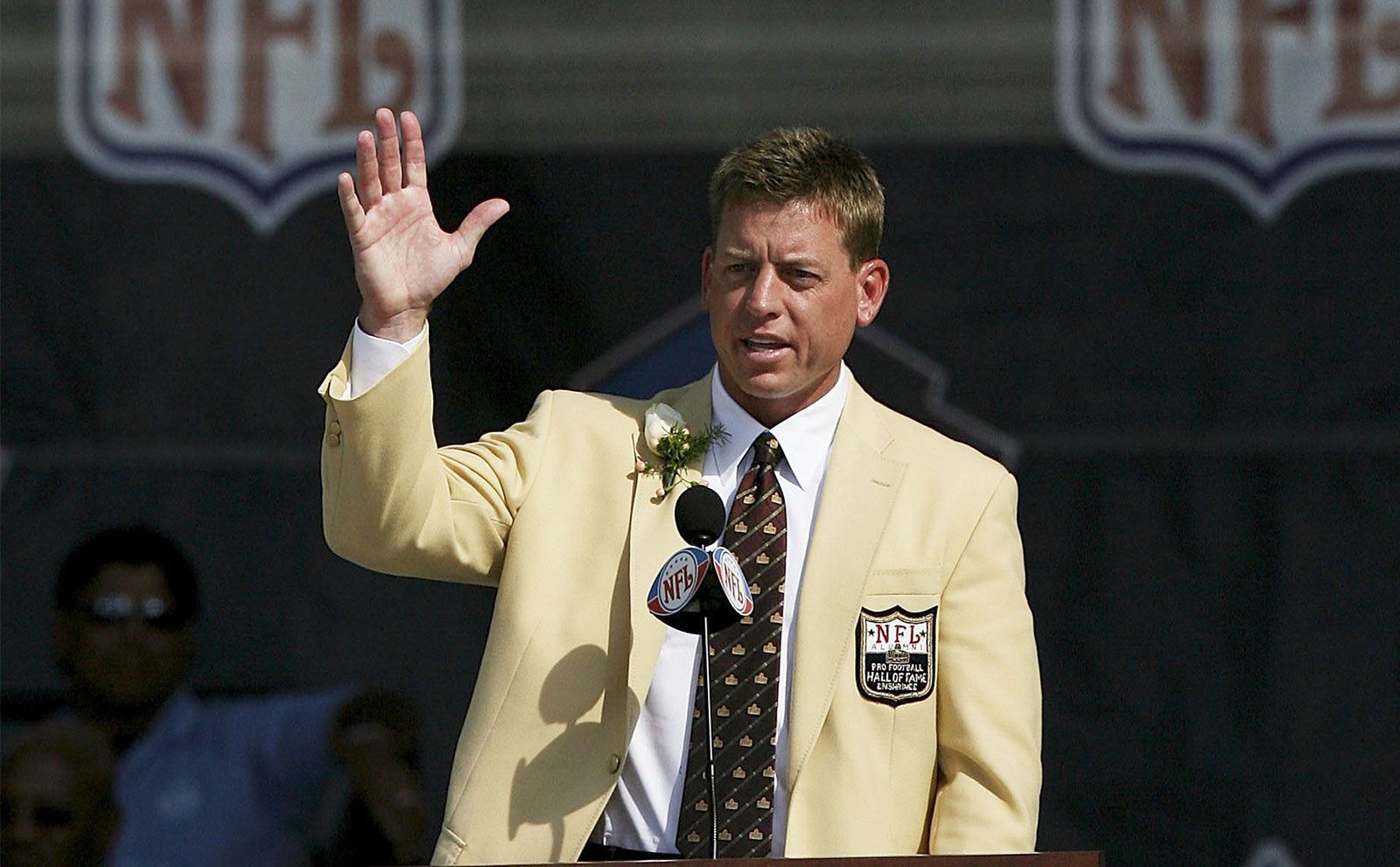
- Pro Football Hall of Fame Class of 2006
The 49ers Rivalry: Battle for the Decade
To understand Troy Aikman’s greatness, one must look at the Cowboys’ rivalry with the San Francisco 49ers. Between 1992 and 1995, the winner of the NFC Championship Game between these two teams went on to win the Super Bowl every single year. It was the “de facto” Super Bowl.
Aikman’s performance in the 1992 NFC Championship at a muddy Candlestick Park is legendary. His 70-yard touchdown pass to Alvin Harper is etched in Cowboys lore. While Steve Young was the more mobile, versatile threat, Aikman was the “Ice Man.” He was rarely rattled by the 49ers’ complex blitzes, maintaining his poise and delivering the ball with unmatched timing.
The Mechanics of Excellence: Why Aikman was Elite
Football analysts often point to Aikman’s “ball placement” as his greatest asset. He didn’t just hit the receiver; he hit the receiver on the specific shoulder that allowed for the most yards after the catch (YAC).
His drop-back was rhythmic—precisely three or five steps, a quick plant, and a high release. This technical perfection allowed him to thrive even under immense pressure. However, this style came at a cost. Aikman suffered numerous concussions during his career, at a time when the NFL’s understanding of head trauma was in its infancy. These injuries eventually led to his relatively early retirement at age 34.
Transition to Media: Defining the Television Era
When Troy Aikman retired in 2000, he immediately moved into the broadcast booth. Joining FOX Sports, he displayed the same preparation and directness that he showed on the field. In 2002, he was paired with Joe Buck, forming a partnership that would last over two decades.
In 2022, Aikman and Buck made the high-profile move to Monday Night Football on ESPN. Aikman’s salary, reported at $18 million per year, set a new benchmark for sports analysts. His “no-fluff” commentary style—often criticizing poor quarterback play or bad officiating regardless of the player’s stature—has made him a fan favorite for those seeking honest analysis.
Business & Philanthropy: The Eight Beer Legacy
Beyond the field and the booth, Troy Aikman has become a titan of industry. In 2022, he launched EIGHT Elite Light Lager. Unlike many celebrity-endorsed products, Aikman was involved in the chemistry and development of the beer, aiming for a “clean” ingredient profile for health-conscious athletes.
His philanthropic work through the Troy Aikman Foundation has focused on building “Aikman’s End Zones” in children’s hospitals, providing play areas for kids undergoing long-term treatment. This commitment to the community earned him the Walter Payton Man of the Year award during his playing days, an honor he still considers his most cherished.
Frequently Asked Questions
How much did Troy Aikman sign for at ESPN?
Troy Aikman signed a five-year deal with ESPN in 2022 worth an estimated $90 million, making him one of the highest-paid broadcasters in history.
Why did Troy Aikman retire so early?
Aikman retired primarily due to a series of concussions and chronic back pain. He suffered ten documented concussions during his 12-season career, and he chose to prioritize his long-term health over continued play.
Was Troy Aikman better than Steve Young?
This is a classic debate. Young had better statistical efficiency and rushing ability, but Aikman had more Super Bowl rings (3 to Young’s 1 as a starter) and was considered the superior “pure” pocket passer in a traditional system.
Does Troy Aikman still live in Dallas?
Yes, Troy Aikman remains a prominent resident of the Dallas area, specifically in the Highland Park neighborhood, where he is active in the local business community.