

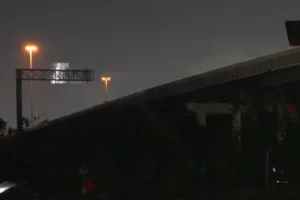
On the evening of October 23, 2025, a horrifying discovery was made beneath the I‑610 North Loop Freeway (North Loop East) in northeastern Houston: the body of a man hanged from a rope and partially burned.
This article unpacks the known facts, the investigation, possible motives, the broader implications, and what it means for the community—while optimizing for visibility so that more people can learn about this important case.
What happened? — The Facts as We Know Them
1. Discovery of the scene
- Around 10 p.m., employees of Union Pacific railroad noticed what they believed was a brush fire beneath the overpass at 7800 + North Loop East.
- When the Houston Fire Department (HFD) arrived, they discovered a male body hanging by a rope under the overpass, which appeared to be burned, or “set on fire, partially.”
- The location is adjacent to a suspected homeless encampment.
2. Identity of the victim
- The victim has been identified as Jeremy Glen Carnes, aged 46 (some sources list 45) at the time of death.
- According to family members, Carnes had experienced a childhood burn injury and had longstanding fear of fire (“he hated fire”).
- He was described as a kind, friendly person who connected easily with others and helped people in his neighborhood.
3. Investigation status
- The Houston Police Department (HPD) homicide division is investigating the incident as likely homicide, stating suicide is “very unlikely”.
- An autopsy is pending by the Harris County Institute of Forensic Sciences to determine cause and manner of death.
- Investigators have not yet publicly disclosed suspects, and no reliable eyewitnesses have come forward.
- HPD is urging anyone with information to contact Homicide Division at 713-308-3600 or Crime Stoppers at 713-222-TIPS.
Why this case stands out
Extraordinary and disturbing circumstances
It’s rare to find a case where a body is both hanged and set on fire. Most deaths by hanging are suicides or homicides without fire. The addition of fire suggests an extra layer of violence, possible intent to destroy evidence, or extreme cruelty.
Victim’s background adds complexity
Carnes’ history—having been burned badly as a child, his fear of fire, and his described nature as a kind person—makes his death even more perplexing and tragic. His family strongly rejects the idea that he took his own life.
Homelessness, vulnerable populations, and crime
The scene’s proximity to a homeless encampment raises larger issues about safety for homeless individuals and how violence in these encampments may go under-reported. The victim himself was described as having been homeless and struggling with mental health/substance issues.
Investigation challenges
Fire often destroys key forensic evidence; hanging adds complexity regarding timing, cause of death (hanging vs burns), positioning, and method. The fact the scene was initially treated as a brush fire also may have hampered evidence-preservation.
What we still don’t know — Key questions
- Cause of death: Was death due to hanging (asphyxiation), burns (thermal injury, smoke inhalation) or both? Autopsy results are pending.
- Motive: Why was Carnes targeted? Was it racial/hate violence, fire-related rage, a random attack, robbery, mental health episode, or other motive?
- Chain of events: How did the hanging and fire occur—was the hanging first, then fire? Or fire first to cover up homicide? Was the rope placed and body then burned?
- Perpetrator(s): Who is responsible? Are there any security-camera videos or witness statements?
- Encampment role: Was the homeless encampment targeted? Was Carnes there voluntarily or as a victim? Are other encampment residents at risk?
- Timing: How long was the body hanging before discovery? What fire burns did the victim suffer, and how long was he alive after hanging?
The human story — Remembering Jeremy Glen Carnes
Early life and personality
According to his obituary and family statements, Carnes grew up in Duncan, Oklahoma, and spent much of his childhood in Liverpool, Texas. He was known by the nickname “Boogie,” and described as “fearless, funny, happy and sweet.”
Struggles and resilience
Carnes experienced a serious burn injury when he was three years old, which left face scars. He reportedly developed a lifelong fear of fire as a result. Later in life he lived in the Houston area, did odd jobs, and was present helping children and neighbors.
Family’s grief and pursuit of justice
His sister, Commilla Kidd, is quoted saying: “For anybody to say that he did this to himself, our family’s going, you don’t know him.” Another quote: “I’m just not going to stop until I get justice for my brother.”
The family is pleading with the public: homeless people “are human … don’t look at them and not see a human.”
Investigative and forensic considerations
Fire scene complications
- Fire can consume or disturb materials like rope fibers, ties, ligature marks, accelerants, etc.
- It may also alter the body, complicating autopsy (e.g., burn artifacts, inhalation injury vs hanging).
- Investigators must determine if fire was staged, secondary, or integral.
Hanging/ligature investigation
- The rope, knot type, height/suspension point under the overpass all matter.
- Was the rope affixed to a fixed object? Was the body suspended from exhaustion or forced?
- Are there signs of binding vs passive suspension?
Combined mechanisms
- If the victim was hanged and then set on fire, homicide is extremely likely (per HPD).
- If the fire occurred first and then hanging, the motive may include destroying evidence.
- If hanging first and no fire, basic homicide; the fire elevates the intended cruelty.
Vulnerable victim considerations
- Homeless victims may lack routine welfare checks, which delays discovery.
- Encampment locations may lack surveillance, reducing evidence availability.
- Perpetrators may assume victims are less likely to draw aggressive investigative focus.
Social implications & broader context
Violence against homeless individuals
Carnes’ case highlights the vulnerability of homeless people to extreme violence. According to HPD, the death happened near an encampment.
Mental health and substance use
The family reports Carnes used odd jobs and had mental health/substance-use issues. Vulnerable individuals may be less able to protect themselves or escape danger.
Community and public safety
When crimes occur in less-patrolled areas like underpasses, railroad rights-of-way, homeless encampments, response can be delayed. Faster discovery could assist investigations and reduce risk to others.
Media & public attention
Cases like this may receive limited attention despite their brutality. A well-written article with proper keywords can help raise awareness, encourage tips to police, and remind the public that every life is valuable.
What can the public do?
- Report any information: If you were in the area (7800 block of North Loop East) between October 22–24 and observed suspicious activity near the underpass, report it to HPD at 713-308-3600 or Crime Stoppers at 713-222-TIPS.
- Raise awareness: Share this story via social media, community bulletin boards, or local neighborhood groups.
- Support vulnerable populations: Many crimes target people with limited resources; support organizations that outreach to homeless individuals.
- Advocate for safer encampments: Local municipalities might consider improved lighting, surveillance, and safe-outreach services in known encampment areas.
Case Significance: What We Learn
This tragic incident serves as a stark reminder of several profound issues:
- The brutality of violence targeted at vulnerable people.
- The complexity of forensic investigation when multiple causes (hanging + fire) overlap.
- The importance of prompt discovery and reporting for crimes in marginalized communities.
- The need for society to view every individual as worthy of justice, regardless of housing status.
- The value of media coverage and public attention in mobilizing resources and assistance.
Closing Thoughts
The death of Jeremy Glen Carnes is more than a statistic. It is a human life violently ended under horrific circumstances. His family’s grief, the unanswered questions, and the potential for justice are all intertwined. By highlighting the case, sharing accurate information, and engaging in community vigilance, we can help ensure that this incident does not fade into obscurity—and that the vulnerable among us are remembered and protected.
If you have any information related to this case, please contact the Houston Police Department or Crime Stoppers immediately.