

Published: January 2026 | Comprehensive Editorial Update
Introduction: The Viral Identity Crisis
In the lexicon of German health, the word Erkältung suggests a predictable sequence: a scratchy throat, a few days of sneezing, and a swift return to normalcy. However, a significant percentage of these cases are not caused by the standard Rhinovirus but by a far more persistent pathogen: the Adenovirus.
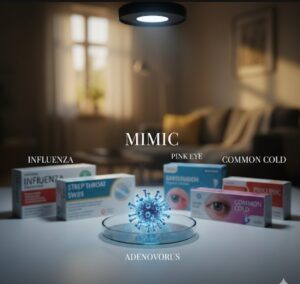
Adenoviruses represent a group of viruses that are masters of disguise. They don’t just cause “a cold”; they can trigger symptoms that perfectly mirror strep throat, influenza, pneumonia, and even viral conjunctivitis. Because their clinical presentation is so varied, Adenovirus is often the hidden culprit behind “the cold that wouldn’t go away.” This 2000-word guide examines why this virus is so effective at mimicking its peers and what you need to do when it enters your household.
The Molecular Biology of Adenovirus
To understand why an Adenovirus Erkältung feels different, we must look at its structure. Most respiratory viruses, like the Flu or COVID-19, are “enveloped” viruses. They are surrounded by a lipid (fatty) membrane. While this helps them fuse with human cells, it also makes them fragile. Soap and alcohol easily destroy that fatty layer, killing the virus.
Adenoviruses are non-enveloped. They are encased in a tough protein shell (a capsid) with protruding fibers that act like grappling hooks to latch onto host cells. This “armored” structure provides two primary advantages to the virus:
- Environmental Durability: Adenovirus can survive for weeks on plastic or metal surfaces, whereas the flu might die within hours.
- Resistance: They are resistant to many common household cleaners and can even survive the acidic environment of the human stomach, allowing them to cause gastrointestinal issues alongside respiratory ones.
The Mimicry: Adenovirus vs. Other Illnesses
The “Great Mimic” earns its name by activating the same immune pathways as other major diseases. Here is a breakdown of how it confuses patients and clinicians alike.
1. The “Super Cold” Phenomenon
While a Rhinovirus-induced cold usually lingers for 5 to 7 days, an Adenovirus infection often persists for 14 days or longer. This leads many patients to believe they have developed a secondary bacterial infection or a “superbug.” In reality, the virus’s DNA structure simply takes longer for the human immune system to decode and clear.
2. Misidentification as Influenza (The Flu)
Influenza is characterized by a rapid onset of high fever, muscle aches, and extreme fatigue. Adenovirus, particularly types 3, 4, and 7, can produce an identical “systemic” response. Patients often experience fevers exceeding 39°C (102°F) that last for five days or more—significantly longer than the typical 48-hour fever spike seen in minor colds.
3. The Strep Throat Illusion
One of the most common diagnostic errors involves Pharyngoconjunctival Fever (PCF). Adenovirus can cause the tonsils to swell and become covered in white exudate (spots). To the naked eye, this is indistinguishable from bacterial Strep throat. This leads to thousands of unnecessary antibiotic prescriptions every year, which do nothing to stop the virus.
Transmission Dynamics & Environmental Resilience
How does Adenovirus spread so effectively? Its transmission vectors are more diverse than almost any other respiratory virus. It utilizes Multimodal Transmission:
- Droplet Transmission: The standard route through coughing and sneezing.
- Fecal-Oral Route: Because the virus can survive the gut, it is often shed in stool. This is why outbreaks are so common in daycares (diaper changes) and among young children who are still refining their hygiene habits.
- Fomite Transmission: Because of its non-enveloped protein shell, it can live on a classroom desk for up to 30 days. A child can touch that desk, touch their eye three weeks later, and become infected.
Special Considerations: Adenovirus in Children
For adults, an Adenovirus Erkältung is an annoyance. For children, it can be more intense. Adenoviruses are responsible for roughly 5% to 10% of all childhood respiratory infections.
In children, the virus often manifests as Croup (a barking cough) or Bronchiolitis. Parents should be particularly aware of the combination of a sore throat and red, itchy eyes. If your child has a “cold” that is accompanied by “pink eye,” there is a 90% statistical likelihood that the culprit is Adenovirus.
The Diagnostic Challenge
In 2026, we have more diagnostic tools than ever, but Adenovirus often slips through the cracks because it isn’t always included in standard “rapid” panels.
If you visit a clinic, the doctor may perform a Multiplex PCR Test. This is a single swab that looks for the genetic signatures of 20+ viruses at once. Identifying Adenovirus is crucial because it prevents the misuse of antibiotics. However, because there is no specific “cure,” many doctors will diagnose based on clinical signs—specifically the triad of Fever, Pharyngitis, and Conjunctivitis.
| Symptom | Adenovirus | Common Cold | Influenza | COVID-19 |
|---|---|---|---|---|
| Fever Duration | 5–10 days | Rare/Short | 3–5 days | Variable |
| Pink Eye | Very Common | Rare | No | Occasional |
| Cough Type | Dry, hacking | Productive | Dry/Painful | Dry/Persistent |
| Antibiotics? | No | No | No | No |
Holistic & Clinical Treatment Strategies
Since the medical community lacks a widely available antiviral for Adenovirus (Cidofovir is reserved only for severe, hospitalized cases), management is entirely supportive. The goal is to keep the patient comfortable while the immune system does the heavy lifting.
1. Managing the Fever
Because Adenovirus fevers are stubborn, “cycling” antipyretics (alternating Paracetamol and Ibuprofen every 4 hours) is a common recommendation under medical supervision. This keeps the temperature stable and reduces the risk of febrile seizures in prone children.
2. Ocular Care
If the virus spreads to the eyes, do not use antibacterial eye drops unless a secondary infection is suspected. Instead, use artificial tears and cold compresses. The “pink eye” caused by Adenovirus is viral and will resolve as the respiratory symptoms fade.
3. Respiratory Support
Honey has been scientifically proven to be as effective as dextromethorphan (cough suppressant) for nighttime coughs in children over age one. For adults, NAC (N-acetylcysteine) may help thin the mucus, though its efficacy varies.
Modern Prevention Protocols
In a post-pandemic world, our understanding of hygiene has evolved. To prevent an Adenovirus Erkältung, one must look beyond the mask. Because the virus is so stable on surfaces, surface disinfection is key. Use cleaners labeled as “virucidal” or those containing bleach for high-touch areas like light switches and remote controls.
Furthermore, because the virus can be shed in the stool for weeks after the respiratory symptoms have cleared, continue meticulous handwashing long after you feel “better.” This is the primary way the virus cycles through schools and offices.
Conclusion
The Adenovirus Erkältung is more than just a common cold. It is a resilient, DNA-based pathogen that tests the limits of our immune systems and our diagnostic capabilities. By recognizing its hallmark symptoms—the prolonged fever, the severe sore throat, and the tell-tale pink eye—we can avoid unnecessary treatments and focus on the rest and hydration needed for recovery.
While the “Great Mimic” may fool us for a few days, understanding its biology empowers us to manage the infection with confidence. Stay hydrated, wash your hands with soap, and give your body the time it needs to win the battle.