
Emotional Ergonomics: The New Frontier in Product Development
Beyond Utility: The Rise of the Emotional Interface
For decades, the mantra of product development was “form follows function.” If a tool worked and didn’t cause physical strain, it was considered a success. However, as we navigate the mid-2020s, the market is saturated with functional products. In this landscape, functionality is no longer a competitive advantage—it is a baseline requirement. The true differentiator in modern industry is Emotional Ergonomics.
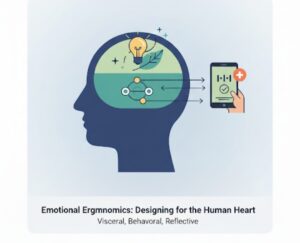
Emotional Ergonomics is the practice of designing products that align with the user’s psychological state, aspirations, and subconscious desires. It is the bridge between a “user” and a “human.” When a developer ignores the emotional layer, they risk creating “cold technology”—products that are efficient but evoke no loyalty, leading to high churn rates and brand indifference.
Foundations: Defining Emotional Ergonomics
According to the Emotional Ergonomics Design Guide for Product Developers, this discipline is defined as “the optimization of human-system interactions by addressing the psychological, social, and emotional needs of the user.” Unlike cognitive ergonomics, which focuses on mental workload and decision-making, emotional ergonomics focuses on affective outcomes.
Emotional friction occurs when a product’s interface or physical form contradicts the user’s emotional intent. For example, a “luxury” car app that lags or uses “cheap” sounding notification tones creates high emotional friction, shattering the brand promise.
The Tripartite Model: Visceral, Behavioral, and Reflective
To master emotional design, developers must address three distinct layers of the human brain, as outlined in our primary reference guide.
1. The Visceral Level (The Pre-conscious)
This is the domain of sensory perception. It is the “wow” factor when you unbox a new smartphone or the “ugh” feeling of a cluttered website. Visceral design is about immediate impact. Developers should focus on:
- Sensory Harmony: The weight of a device, the texture of the plastic, and the frequency of the startup sound.
- Visual Priming: Using shapes that evoke safety (rounded corners) or precision (sharp, clean lines).
2. The Behavioral Level (The Joy of Use)
This level is about the experience of doing. Behavioral ergonomics is achieved when the product disappears and the user enters a “flow state.” Features include:
- Predictability: The product behaves exactly as the user’s mental model suggests.
- Empowerment: The user feels more capable while using the tool than they do without it.
3. The Reflective Level (The Identity)
This is the highest level of thought. It involves the user’s self-image and personal story. Does using this sustainable, recycled-plastic laptop make the user feel like a responsible global citizen? This is where long-term brand evangelism is born.
The Neuroscience of User Delight
Why does a smooth animation feel better than a jagged one? It comes down to Processing Fluency. The human brain is hardwired to prefer information that is easy to process. When a product developer utilizes emotional ergonomics—such as logical information grouping or natural haptic feedback—they are literally reducing the metabolic cost of using the product.
| Neurochemical | Design Trigger | User Feeling |
|---|---|---|
| Dopamine | Reward systems, micro-interactions, achievement badges. | Motivation and “Crave” for more interaction. |
| Oxytocin | Personalized messaging, human-centric copy, community features. | Trust and Brand Belonging. |
| Endorphins | Surprise and delight, humorous error messages, sleek aesthetics. | Stress reduction and relaxation. |
The Development Workflow: Integrating Emotion into Agile
Emotional ergonomics cannot be “sprinkled on” at the end of a project. It must be baked into the Product Development Life Cycle (PDLC). The Design Guide recommends the following integration:
Discovery Phase: Affective Personas
Don’t just define your user by age and job title. Define them by their Emotional Disposition. Are they “Anxious and Time-Pressed” or “Curious and Exploratory”? A tool for an anxious user requires high levels of reassurance and simplified choices.
Prototyping Phase: The “Lust” Test
During early prototyping, show users the product for only 5 seconds. If their first reaction isn’t an emotional connection (Visceral Level), the design needs iteration before functional features are even coded.
Testing Phase: Emotional Valencing
Use the Self-Assessment Manikin (SAM) scale to measure Pleasure, Arousal, and Dominance. If a user feels “Low Dominance,” it means your product makes them feel controlled or confused—a red flag for emotional ergonomics.
Measuring the Unmeasurable: Emotional KPIs
How do you justify the cost of emotional ergonomics to stakeholders? You track the Return on Emotion (ROE). Data suggests that emotionally engaged customers are three times more likely to repurchase.
- Emotional NPS (Net Promoter Score): Instead of asking “Would you recommend?”, ask “How did you feel after using this?”
- Task Satisfaction Score (TSS): Measures the “Behavioral” level of design.
- Dwell Time vs. Frustration Time: Distinguishing between a user who is “lost” and a user who is “engaged.”
Ethical Considerations and the ‘Dark Patterns’ Trap
With great power comes great responsibility. Understanding emotional triggers allows developers to manipulate users (e.g., using “fear of missing out” to drive sales). True emotional ergonomics, as outlined in our reference guide, focuses on Psychological Well-being. Developers must avoid “Dark Patterns” that exploit emotional vulnerabilities, as these ultimately lead to “Reflective Regret”—the moment a user realizes they were manipulated and abandons the brand forever.
Conclusion: Designing for the Human Soul
The Emotional Ergonomics Design Guide for Product Developers teaches us that products are more than just assemblies of code and plastic. They are participants in the human experience. As we look toward the future of 2026 and beyond, the most successful developers will be those who can empathize with the silent frustrations and unvoiced dreams of their users.
By mastering the Visceral, Behavioral, and Reflective layers, you create more than a product—you create a meaningful connection. The future of design isn’t just smart; it’s emotional.
Good article. I will be facing many of these issues
as well.. https://Play.talkdrove.Cc.nf/@jamiemcintyre?page=about