
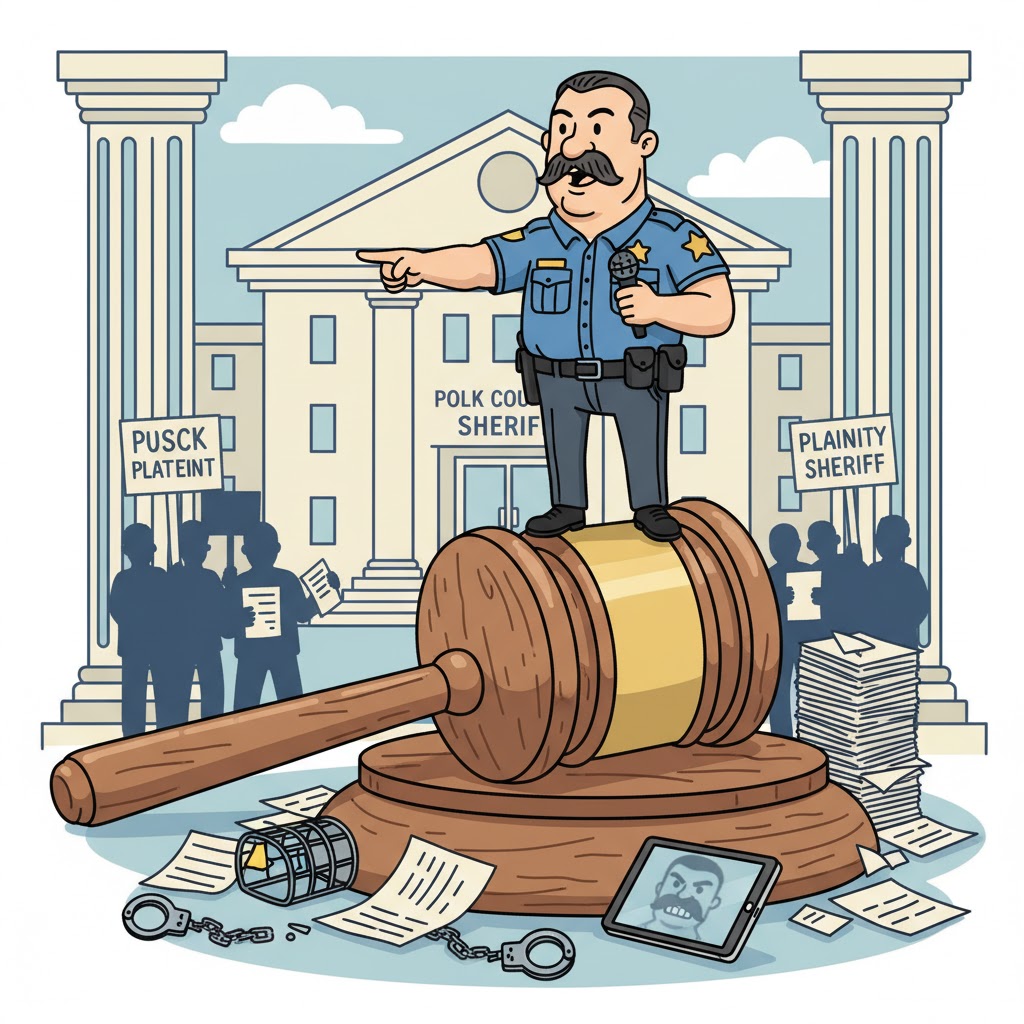
Polk County Sheriff Grady Judd has cultivated a reputation far beyond Central Florida. Known for his candid, tough-on-crime press conferences and memorable, often quoted soundbites, he is a figure synonymous with unapologetic law enforcement. However, this high-profile image and the aggressive policing policies it often reflects have inevitably placed him and the Polk County Sheriff’s Office (PCSO) at the center of significant legal challenges.
These lawsuits—ranging from allegations of systemic jail abuse and inadequate mental healthcare to claims of malicious prosecution and failure to protect victims—do more than just challenge individual deputies’ actions; they scrutinize the very institutional culture and official policies established under Sheriff Judd’s nearly two decades of leadership. The pattern of litigation reveals the complex legal and ethical tightrope walked by an elected official whose public persona is inextricably linked to his official capacity as the county’s top law enforcement officer.
The Central Tenets of the Lawsuits: Challenging Institutional Policy
In the American legal system, particularly under federal civil rights law (§1983), lawsuits against a government entity like the Sheriff’s Office are typically not successful by simply alleging an employee made a mistake. To hold the Sheriff’s Office liable, the plaintiff must prove that the injury was the result of a policy, practice, or custom established by the final policymaker—the Sheriff himself. This is known as the Monell doctrine.
Consequently, lawsuits targeting Sheriff Judd focus squarely on challenging the institutional culture, training, and operational procedures of the PCSO, asserting that these systems are deliberately indifferent to the constitutional rights of citizens and detainees.
1. The Juvenile Jail Abuse Case: Hughes v. Sheriff Grady Judd
One of the most significant and detailed civil rights cases against Sheriff Judd involved the conditions of confinement for juvenile detainees in the Polk County Jail.
The Background: A Policy Shift
In 2011, a shift in Florida state legislation allowed counties to house children charged as juveniles in adult jail facilities under county jail standards, rather than the stricter standards of the Department of Juvenile Justice (DJJ). Sheriff Judd was one of the first in the state to implement this change, citing cost-saving measures. This decision immediately drew legal scrutiny.
The Allegations: Cages and Chemical Agents
In March 2012, the Southern Poverty Law Center (SPLC) filed a federal class-action lawsuit, Hughes v. Sheriff Grady Judd, on behalf of a group of juvenile prisoners. The lawsuit painted a disturbing picture of the conditions juveniles, some as young as eight, were subjected to:
- Punitive Confinement: Children were allegedly punished with isolation, lockdown, and being placed in an open-sided cage known as a “suicide watch” cell—sometimes for days—for minor infractions. The SPLC alleged that these “suicide watch” conditions were used punitively, not therapeutically.
- Use of Chemical Agents: Guards were accused of regularly brutalizing children by spraying them with harsh chemical agents, such as pepper spray, for minor issues like taking too long to get dressed. The suit detailed how this abuse continued even for children who had been stripped and placed in anti-suicide suits.
- Inadequate Services: Crucially, the lawsuit claimed a severe lack of rehabilitative services, abysmal educational provisions, and systematic failure to provide adequate medical and mental health care to juveniles with serious psychiatric needs. Mentally ill children were allegedly denied prescribed medication or given it irregularly.
The SPLC framed the issue as a failure of policy, arguing that Judd’s decision to house juveniles in an adult facility, staffed by guards lacking expertise in child welfare, demonstrated a deliberate indifference to the youths’ Eighth and Fourteenth Amendment rights against cruel and unusual punishment.
The Outcome and Legacy
The court case proceeded for years, culminating in a 2015 judgment in favor of Sheriff Judd and the health care provider, Corizon Health, Inc. The presiding judge, while acknowledging the detailed allegations, ultimately ruled that the plaintiffs failed to prove that the defendants demonstrated deliberate indifference to a substantial risk of serious harm, and that the defendants’ policies were, in fact, unconstitutional.
Despite the judicial ruling in his favor, the lawsuit brought unprecedented public attention to the practice of housing juveniles in adult jails in Florida, becoming a central cautionary tale in the national debate over juvenile justice reform. The mere existence and extensive detailing of the alleged conditions placed significant pressure on the PCSO’s jail operations.
2. The Malicious Prosecution Lawsuit: The Child Rape Victim Blunder
More recently, a lawsuit filed against Sheriff Judd and two detectives drew sharp criticism for directly challenging the agency’s investigative protocols, particularly in cases involving minors and sexual assault.
The Core Allegation: Criminalizing the Victim
The lawsuit, filed by a victim identified as Taylor Cadle, centered on a 2016 investigation into her allegations of sexual battery by her uncle. The core of the claim was the detectives’ handling of her initial report:
- After a preliminary investigation, PCSO detectives concluded that the young girl had fabricated the abuse.
- Instead of continuing the investigation, the Sheriff’s Office moved to charge the victim with giving false information to a law enforcement officer.
- Under pressure from her family to “just get the case over with,” the 13-year-old victim pleaded guilty to a felony charge, was placed on probation, and was forced to write letters of apology to both the Sheriff’s Office and her alleged abuser—the very man who would later rape her again.
The Irrefutable Evidence and Subsequent Conviction
Less than a month after her plea, the victim was again sexually assaulted by her uncle. This time, however, she secretly recorded the incident. When confronted with the video and photographic evidence, her abuser admitted the crime. The PCSO then moved to withdraw the victim’s original guilty plea, and the abuser was ultimately sentenced to 17 years in prison.
The lawsuit filed against Sheriff Judd and the detectives accuses the PCSO of malicious prosecution and failure to train staff on how to properly approach child sexual abuse cases. It specifically targets the agency’s culture, stating that Sheriff Judd’s “tough-on-crime rhetoric” and the “criminalization of minors for making false statements” encouraged and authorized a disregard for the constitutional rights of victims. This case presents a direct challenge to the agency’s investigative culture and the internal checks and balances governing detective discretion.
3. Public Relations and Constitutional Rights: The Press Conference Controversies
A lesser-discussed but recurring legal theme stems from Sheriff Judd’s famed, highly public press conferences, where he often names and shames suspects in explicit, judgmental terms before they have been formally convicted.
The False Accusation Lawsuit
One Florida man filed a lawsuit against Judd and a deputy, claiming false arrest and malicious prosecution after he was targeted in a PCSO undercover sting, Operation Guardians of Innocence V, aimed at child predators. The plaintiff claimed he was targeted and falsely accused based solely on a phone number he no longer used.
While being targeted in a law enforcement sting is one thing, the legal injury was compounded by Sheriff Judd’s public actions. The Sheriff publicized the arrests, publicly announcing the names and addresses of the arrestees, resulting in the plaintiff’s immediate loss of his job as a nurse and severe emotional distress and humiliation over the false charges. The lawsuit argues that Judd’s policy of immediate, high-profile public shaming is a practice that causes irreparable damage even when the charges are eventually dropped or proven false.
This type of litigation tests the boundary between a public official’s right to inform the public about an arrest and a citizen’s constitutional rights, including due process and protection from state-sponsored defamation that can effectively act as a punishment before trial.
4. Other Recurring Lawsuit Themes
The legal issues facing the Polk County Sheriff’s Office also align with common challenges faced by law enforcement agencies nationwide:
- Excessive Force and Wrongful Death: As with any large, active police force, the PCSO faces lawsuits alleging that deputies used excessive, and sometimes deadly, force during arrests or encounters. These cases often involve complex analyses of state law, departmental use-of-force policies, and whether the deputy’s training was deliberately deficient—again, pointing back to the Sheriff’s policy-making role.
- Employment Discrimination: Sheriff’s Offices are also employers. Lawsuits occasionally emerge from within the department, alleging discrimination in hiring, promotion, or termination based on race, gender, or age, challenging the internal fairness and constitutional compliance of the PCSO’s human resources and command structure.
The Cost and Defense of Litigation
The constant stream of lawsuits, regardless of their ultimate outcome, imposes a significant financial burden on Polk County taxpayers. Sheriffs in Florida, as independent constitutional officers, generally maintain their own budgets, including funds for legal defense and liability settlements.
Sheriff Judd has historically taken a defiant posture in response to civil suits, often characterizing them as “frivolous” and promising to “vigorously defend” his deputies’ actions. This aggressive legal defense strategy, while reinforcing his tough-on-crime image, translates into substantial ongoing legal expenses for the county. Even in cases he wins, the cost of litigation—discovery, expert witnesses, trial time, and appellate review—is considerable. When cases are settled or lost, the multi-million dollar payouts come directly from taxpayer-funded reserves, ultimately impacting the public safety budget available for other critical functions.
A Sheriff Defined by Conflict
The legal battles surrounding Sheriff Grady Judd are more than just a list of court filings; they are a critical examination of how an agency operates when led by a figure who embraces a public policy of zero-tolerance and maximum publicity. The lawsuits concerning juvenile jail conditions, the malicious prosecution of a child rape victim, and the defamation inherent in aggressive press conferences all allege a systemic problem: that the Polk County Sheriff’s Office, under its current leadership, has fostered policies that prioritize sensationalized results and public image over meticulous adherence to constitutional procedure and victim advocacy.
While Sheriff Judd remains overwhelmingly popular among his constituents, securing re-election multiple times, the continuous and varied litigation serves as the official, constitutional counter-narrative to his public persona. The courts provide the mechanism to challenge the impact of his policies, forcing the PCSO to constantly defend its practices—and often, to pay for the consequences—in a long-running conflict between an outspoken lawman and the constitutional rights of the people he is sworn to protect.