
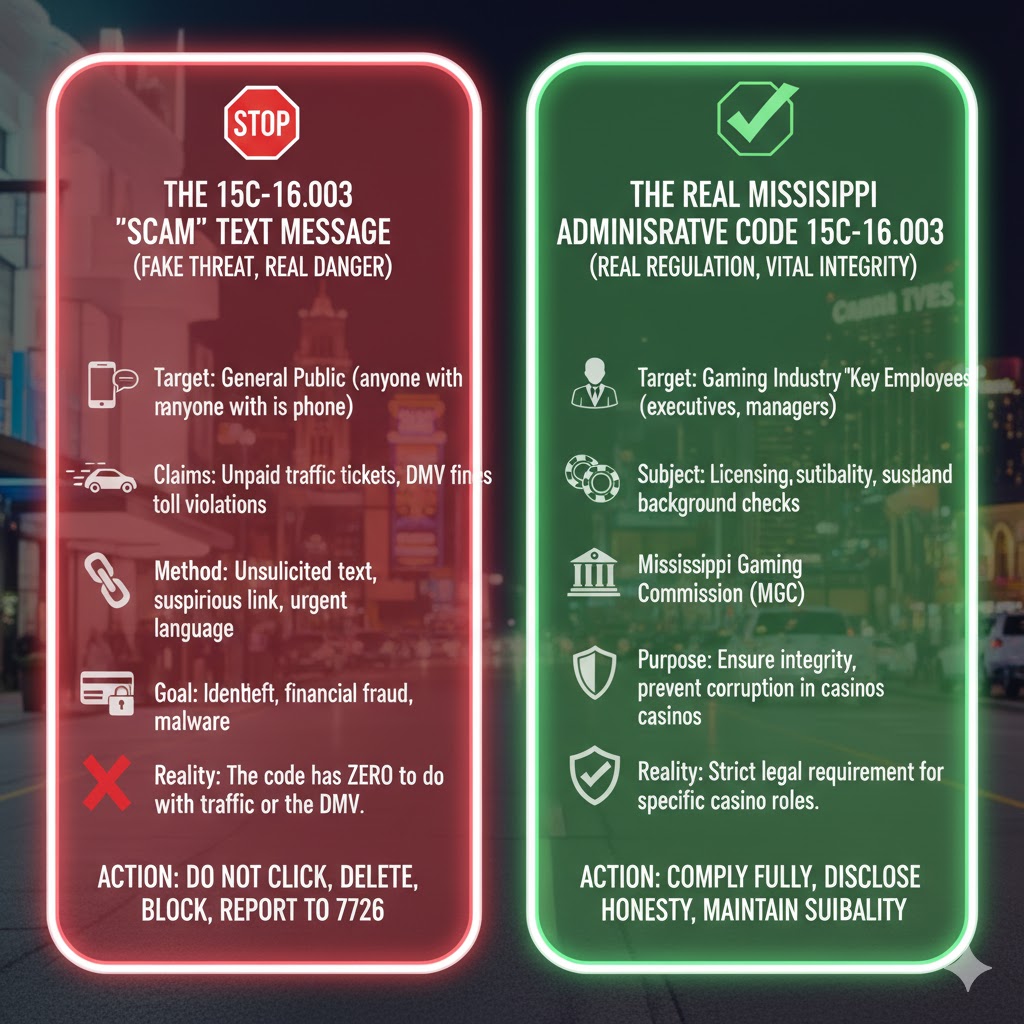
Have you recently received a cryptic text message claiming you have an unpaid traffic ticket or a delinquent toll payment, threatening “final enforcement” under a mysterious section of law: Mississippi Administrative Code 15C-16.003?
If so, you are not alone. This message is part of a massive, sophisticated, nationwide text message phishing scam (smishing) that preys on panic and a lack of legal knowledge. It is a well-engineered fraud designed to steal your personal and financial information.
The critical truth you need to know is this: Mississippi Administrative Code 15C-16.003 is NOT a law about traffic tickets, tolls, or the Department of Motor Vehicles (DMV).
Read too : Illinois DMV “Final Notice” Text Scam: What You Need to Know
This single legal citation exists in two vastly different contexts, and understanding the difference is essential for both public safety and legal compliance:
- The Fictional “Scam” Context: A dangerous, widespread text message that misuses the code to create a fake sense of urgency and authority, often mentioning “DMV” or “Enforcement Penalties.”
- The Official Regulatory Context: The actual, highly technical regulation governed by the Mississippi Gaming Commission (MGC), which pertains to the licensing and suitability of executives, managers, and other “key employees” within the state’s multi-billion dollar casino industry.
This comprehensive guide will serve as the ultimate resource for both: first, by providing an immediate, actionable warning on how to spot, report, and stop the 15C-16.003 text scam; and second, by providing a detailed breakdown of what the real Mississippi Gaming Commission rule entails for gaming professionals.
Part I: The 15C-16.003 Text Message Scam: A National Consumer Warning
The text message citing Mississippi Administrative Code 15C-16.003 is one of the most effective and widely reported smishing attempts today. Scammers exploit the official-sounding nature of the code to override your better judgment.
The Anatomy of the Fake DMV/Toll Text
While the exact wording varies, these scam texts follow a predictable pattern. They aim to inject a sense of panic and urgency, demanding immediate action:
Example Scam Text: “Final Notice: Your unpaid traffic violation remains outstanding. In accordance with Administrative Code 15C-16.003, enforcement penalties will begin on [Date]. Click here to settle: [Malicious Link]”
🎯 5 Critical Red Flags to Immediately Spot the Scam
Recognizing these key indicators will protect you from clicking the malicious link and compromising your financial data:
- Impersonation of the Wrong Agency: The real 15C-16.003 is under the Mississippi Gaming Commission (MGC). Government agencies like the DMV, Department of Transportation (MDOT), or a local police department do not regulate casino employee licensing. The code has absolutely zero jurisdiction over your personal driving records or traffic citations.
- The Method of Contact: State and local government agencies never initiate contact for unpaid tickets or major enforcement actions via an unsolicited text message. Official warnings are always sent via certified mail, or occasionally, a formal email with instructions to contact a known, verified phone number or visit a .gov domain you navigate to yourself.
- The Threat and Urgency: Scams are built on fear and haste. The threat of immediate “enforcement,” license suspension, or a drastically high penalty is a tactic to prevent you from taking a moment to think or perform a simple Google search (which would lead you right here).
- The Suspicious Link: The link in the text is always malicious. It will not lead to a legitimate government payment portal. It may instead:
- Lead to a spoofed (fake) payment website designed to steal your credit card details and personal identifiers.
- Download malware or spyware onto your phone.
- Generic Wording: The texts are often generic, using phrases like “your traffic violation” or “unpaid toll” without citing the specific citation number, date, or vehicle license plate, because they are sent in bulk to thousands of random numbers.
🛡️ What to Do If You Receive the 15C-16.003 Scam Text
Do not panic, and follow these steps:
- DO NOT CLICK THE LINK: This is the most crucial step. Clicking the link is how you become a victim.
- DO NOT REPLY: Replying confirms to the scammers that your phone number is active, leading to more scam attempts.
- Delete and Block: Immediately delete the message and block the sender’s number.
- Report the Scam: Help authorities track and stop these operations by reporting the text to the following official channels:
- Forward the text message to 7726 (SPAM). This reports the number to your wireless carrier.
- File a complaint with the FTC (Federal Trade Commission) at ReportFraud.ftc.gov.
- Report it to the FBI’s Internet Crime Complaint Center (IC3).
Part II: The Actual Law – Mississippi Administrative Code 15C-16.003
Moving from fiction to fact, it is time to understand the real purpose of this regulation. The actual Mississippi Administrative Code 15C-16.003 is titled “Key Employees” and is a small but vital component of the state’s rigorous regulatory framework for commercial casino gaming.
The Authority: Mississippi Gaming Commission (MGC)
The MGC is the sole regulatory body that governs and enforces all laws related to the operation of casinos and gaming in Mississippi. The primary goal is to ensure the honesty and integrity of the industry. The MGC requires any individual who has a significant influence over casino operations to undergo an exhaustive background check and licensing process to be “found suitable.” This is where 15C-16.003 comes into play.
Defining a “Key Employee” under 15C-16.003
The regulation broadly defines a “key employee” as any executive, employee, or agent of a licensed gaming entity who has the power to exercise significant influence over decisions concerning any part of the licensee’s operation.
This status is not determined by job title alone, but by function and responsibility. Examples of positions that often fall under this definition include:
- Senior Executives: CEOs, Presidents, General Managers, Chief Financial Officers (CFOs).
- Gaming Management: Pit Bosses, Casino Shift Managers, and anyone with authority to supervise a shift of gaming or security activity.
- Decision-Makers: Individuals who exercise a level of influence that could affect the public’s confidence in the integrity of gaming.
The Requirement: Finding of Suitability
Under this regulation, if the Commission determines that the public interest and the policies of the Gaming Control Act require it, the key employee must apply for a Key Employee License or a Finding of Suitability. This is not a formality; it is an intrusive, detailed investigation into the applicant’s life.
Part III: The Rigors of MGC Key Employee Licensing and Suitability 🤵♀️💼
The requirements mandated by the Mississippi Gaming Commission (MGC) under 15C-16.003 are among the most stringent in any regulated industry. The process is a necessary gatekeeping measure to protect the integrity of the state’s casino gaming operations from organized crime and corruption.
The Application: A Comprehensive Self-Disclosure
When an individual is designated a “key employee” by the MGC, the burden of proof to establish suitability rests entirely on the applicant. The licensing process is an exhaustive, intrusive investigation that requires a level of personal and financial disclosure far beyond a typical job application.
The required application, which is typically presented to the Executive Director within thirty (30) days of the employee starting the key position, demands details including, but not limited to:
- Financial Disclosures: A complete net worth statement, including detailed schedules of assets, liabilities, income, and expenditures. This is to ensure the applicant is not financially compromised or susceptible to illegal influences.
- Complete Background History: A review of the applicant’s residential, military, and employment history for the preceding twenty (20) years or more.
- Legal and Regulatory History: Disclosure of all civil, criminal, and regulatory matters, including arrests and convictions, regardless of the jurisdiction or final disposition. The Commission reviews even minor incidents to assess the applicant’s character and judgment.
- Association Disclosures: Information on business relationships and associations that may affect the applicant’s independence or integrity.
The Investigation: An Ongoing MGC Mandate
Once the application is filed, the MGC’s Investigations Division begins its work, often leveraging state, federal, and international resources. The Commission retains the power to require an individual to apply for a finding of suitability at any time, not just upon initial employment, if they determine the person has achieved a level of influence warranting closer scrutiny.
The investigation is concerned with four primary areas, any failure in which can lead to a finding of unsuitability:
- Financial Stability: Is the applicant financially stable and not in a position to be blackmailed or unduly influenced?
- Integrity and Honesty: Has the applicant been truthful in all disclosures? Material misrepresentation or omission is grounds for immediate denial or revocation.
- Reputation and Associations: Does the applicant have a reputation for good character, honesty, and integrity? Are they associated with any persons or organizations deemed unsuitable to the gaming industry?
- Compliance Record: Has the applicant demonstrated respect for the laws and regulations of Mississippi and other jurisdictions?
License Duration and Mandatory Reporting
A Key Employee License is not permanent. The MGC has the discretion to issue a license for a period of up to nine (9) years.
- Renewal: Renewal requires the submission of a new, complete application package and payment of all prescribed fees.
- Expiration: The license is subject to automatic expiration if the holder changes employment or is unemployed as a key employee within the MGC’s jurisdiction for more than ninety (90) days.
Furthermore, a key employee is subject to ongoing scrutiny. The holder must file an “Investigations Division Annual Report” to disclose any changes in financial condition, civil litigation, criminal matters, or changes in professional associations, ensuring continuous compliance with 15C-16.003.
🎯 Key Takeaway for Gaming Professionals
Note: “For professionals in the Mississippi gaming industry, 15C-16.003 is a strict measure of professional integrity. If you are required to apply for a Key Employee License, the application is not merely paperwork—it is the foundation for an extensive background check, and complete, absolute honesty is non-negotiable.”
Part IV: Why Scammers Chose a Gaming Code – The Psychology of the 15C-16.003 Smishing Scam 🧠💸
The selection of Mississippi Administrative Code 15C-16.003 by criminals for a nationwide traffic ticket scam is not random; it is a calculated psychological tactic that capitalizes on a series of predictable human reactions. Scammers, engaged in what is known as smishing (phishing via SMS), rely on three core principles to succeed: Authority, Urgency, and Obscurity.
1. The Principle of Unquestioned Authority 👮
The primary goal of the text is to make you believe a legitimate government agency is threatening you. This is achieved by:
- Citing a Code: The phrase “In accordance with Administrative Code 15C-16.003” instantly sounds official. Most people will never check the true meaning of a state administrative code. By using the term “Administrative Code,” the scammers imply that the action is a non-negotiable, pre-determined bureaucratic process.
- Impersonating a Familiar Agency (DMV): While the code is for the Gaming Commission, the scam text targets the most common bureaucratic fear: losing a driver’s license or facing a hefty fine from the DMV or a Toll Authority. The sheer gravity of facing a licensing authority is enough to bypass critical thinking.
- Leveraging Legitimate Fear: Traffic infractions and tolls are common. The chance that a recipient might have an outstanding violation makes the text just believable enough to warrant a click.
2. The Principle of Manufactured Urgency ⏱️
The text is carefully structured to trigger an immediate, emotional response that overrides logic—a phenomenon known as the “fear-based click.”
- Final Enforcement Warning: Phrases like “Final Notice,” “Final Enforcement Warning,” and “Enforcement Penalties Begin on [Date]” instill fear of immediate, drastic consequences. This high-stakes language forces the recipient to focus on resolving the problem, not verifying its authenticity.
- The Link as the Only Solution: The scam text provides the malicious link as the single, easiest path to resolution. This convenience plays into human preference for the path of least resistance. The recipient is steered away from time-consuming actions like calling the official DMV or visiting a legitimate state website.
3. The Principle of Strategic Obscurity (Why 15C-16.003?) 🤔
Scammers intentionally select highly specific yet obscure codes for several reasons:
- Avoidance of Easy Verification: A more famous, generic code (like a common traffic law statute) would be instantly recognizable as fake or easily checked. 15C-16.003 is too specific for the average person to have heard of but generic enough to sound like a valid bureaucratic rule.
- Code-Hopping for Mass Fraud: The scammers use a template. They can run a mass campaign across different states (Mississippi, California, New York, etc.) by simply changing the state name mentioned in the text, keeping the same official-sounding, yet irrelevant, code 15C-16.003. This lack of synchronization proves the international, large-scale nature of the fraud.
- It’s Not a Real Scam Code: Since the number refers to the Mississippi Gaming Commission—an entity that has nothing to do with everyday citizens paying traffic tickets—it demonstrates a high level of misalignment. The code is authentic but its context in the scam is entirely fabricated, making it a perfect tool to intimidate victims who are already in a state of anxiety.
By exploiting this trifecta of psychological manipulation, the criminals behind the 15C-16.003 scam ensure a steady stream of panicked clicks, ultimately leading to credential harvesting and financial fraud.
The legal and financial repercussions associated with Mississippi Administrative Code 15C-16.003 are bifurcated, depending on whether you are an ordinary citizen facing the fake scam text or a gaming professional facing the real MGC regulation.
Part V: Legal and Financial Repercussions ⚖️💰
Section A: Consequences of the 15C-16.003 Scam (For the Public)
Falling victim to the fake DMV text message citing 15C-16.003 can lead to significant financial loss and long-term legal complications related to identity theft.
| Scam Action | Primary Repercussion | Long-Term Impact |
| Clicking the Malicious Link | Installation of malware or spyware on your device. | Scammers gain access to contacts, photos, and stored login credentials. |
| Entering Credit Card/Bank Info | Immediate Financial Fraud. Funds are stolen directly from your bank account or credit cards are maxed out. | Lengthy process of disputing fraudulent charges and replacing all financial instruments. |
| Submitting Personal Data (SSN, DL #) | Identity Theft. The most severe consequence. | Scammers can open new credit cards, secure fraudulent loans, file fake tax returns, or compromise existing government accounts (like unemployment or real DMV services) in your name. |
| Responding to the Text | Increased Targeted Scams. The scammer confirms your number is active and responsive, leading to you being targeted for even more sophisticated frauds. | Ongoing need to block and report texts, consuming significant time and causing stress. |
Immediate Action for Victims: If you clicked the link or provided any personal information, you must immediately:
- Contact your bank and credit card companies to report the fraud and freeze/cancel compromised accounts.
- Change all passwords on any account that shares credentials or that you accessed after clicking the link.
- Monitor your credit report and consider placing a credit freeze to prevent identity thieves from opening new accounts.
- File an official report with the FTC at ReportFraud.ftc.gov and, if money was lost, with local law enforcement.
Section B: Penalties for Violating the Real 15C-16.003 (For Gaming Professionals)
For individuals who are legitimate Key Employees under the jurisdiction of the Mississippi Gaming Commission (MGC), failure to comply with the requirements of 15C-16.003 carries severe professional consequences, threatening one’s career and standing in the industry.
1. Loss of Licensure and Employment
The MGC has the absolute authority to deny, revoke, condition, or limit any Key Employee License or Finding of Suitability. The grounds for such actions often include:
- Material Omission or Misrepresentation: The most serious violation is lying or failing to disclose required information on the application (e.g., criminal history, debts, associations). This alone is typically grounds for immediate and permanent revocation.
- Conviction of a Disqualifying Crime: Specifically, any felony or certain misdemeanors demonstrating a lack of good moral character or financial integrity.
- Unsuitable Associations: Maintaining a relationship with known criminals or persons deemed detrimental to the honest operation of gaming.
The result of a license revocation is instantaneous termination from the position. The individual is essentially banned from holding any position requiring an MGC license or finding of suitability, effectively ending their career in Mississippi’s casino industry.
2. Disciplinary Action for the Gaming Licensee (The Casino)
The MGC can also hold the casino licensee responsible for allowing an unsuitable or unlicensed individual to serve in a key position. The consequences for the licensee (the employer) can include:
- Fines and Penalties: Substantial monetary fines levied by the Commission.
- Show Cause Hearings: Hearings held to determine why the casino’s license should not be suspended or revoked due to regulatory failure.
In summary, the 15C-16.003 scam can destroy a private citizen’s finances, while the real 15C-16.003 regulation is a powerful mechanism used by the state to protect its gaming industry by ending the career of an unsuitable professional.