

More Than a Feeling, It’s a World
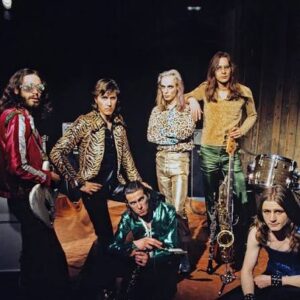
In the sprawling tapestry of popular music, few bands have carved out a space as distinct, sophisticated, and enduringly cool as Roxy Music. Emerging from the art-school scene of early 1970s England, they were not just a band; they were a concept, a carefully curated collision of high art and pop culture, of retro nostalgia and futuristic vision. They looked like a group of stylish aliens who had crash-landed at a 1950s prom, and they sounded like the house band for a glamorous, slightly melancholic cocktail party on the edge of the universe.
Roxy Music was a paradox—simultaneously intellectual and accessible, chaotic and meticulously controlled, emotionally raw and impeccably dressed. They didn’t just write songs; they crafted entire aesthetic universes. This article is a deep dive into the history, sound, and seismic influence of Roxy Music, the artful architects who redefined what a rock band could be and left an indelible mark on everything from punk to new wave to modern alternative music.
Read too : Beyond Borders: The Latin Influence Reshaping Texas Music Culture
The Genesis: Art School and Avant-Garde Ambitions
To understand Roxy Music, one must first understand their origins. They were, at their core, an art-school project. Bryan Ferry, the son of a coal miner, had studied fine art at Newcastle University under pop art pioneer Richard Hamilton. It was here that Ferry developed his fascination with the iconography of American culture, celebrity, and the mechanics of style.
In 1970, Ferry began assembling a band that could articulate his unique vision. He recruited:
-
Graham Simpson on bass, a fellow Newcastle alumnus.
-
Andy Mackay on saxophone and oboe, a classically trained musician with a passion for rock and roll.
-
Brian Eno, a non-musician in the traditional sense, who operated a tape recorder and treated sounds, branding himself as the “VCS3 synthesizer technician.”
The name itself, “Roxy Music,” was a masterstroke. It evoked the glamour of old cinemas (Roxy) while squarely placing them in the contemporary realm (Music). It was nostalgic yet modern, a perfect summary of their impending sound. After a series of early lineup shifts, the classic first-album roster solidified with the addition of Phil Manzanera on guitar and Paul Thompson on drums.
This was not a group of mere instrumentalists; they were a collective of stylists and conceptualists. Their early press photos, often shot by Karl Stoecker, presented them as a gang of individual icons, each with a carefully constructed persona.
Deconstructing the Roxy Sound: A Sonic Patchwork of Genius
The magic of Roxy Music was not in a single element, but in the breathtaking, and sometimes tense, fusion of disparate parts. It was a sound built on creative friction.
1. The Crooner and the Conceptualist: Bryan Ferry & Brian Eno
The most famous and formative tension was between Bryan Ferry and Brian Eno. Ferry was the suave frontman, the romantic crooner whose voice—a quivering, dramatic baritone—channeled the ghosts of 1950s balladeers. He was the curator of the band’s lyrical themes: love as a desperate, glamorous pursuit, nostalgia for a bygone elegance, and the anxiety lurking beneath the surface of modern life.
Eno, by contrast, was the non-musician visionary. He didn’t play traditional instruments but used his VCS3 synthesizer and tape loops to create a sonic bed of treated sounds, ambient textures, and abstract electronic washes. He was the “sound manipulator,” adding an avant-garde, futuristic edge that prevented Ferry’s romanticism from becoming sentimental. Eno was the chaos to Ferry’s control.
2. The Musicians’ Firepower: Manzanera, Mackay, and Thompson
While Ferry and Eno provided the conceptual poles, the band’s musical muscle came from its powerhouse instrumentalists.
-
Phil Manzanera’s Guitar: Manzanera was a versatile and inventive guitarist. He could deliver searing, psychedelic solos (“Ladytron”), choppy, rhythmic funk (“Love is the Drug”), and delicate, atmospheric textures (“A Song for Europe”). His playing was the bridge between the melodic and the experimental.
-
Andy Mackay’s Reeds: Mackay’s saxophone and oboe were utterly unique in a rock context. His oboe provided a haunting, classical melancholy (“Ladytron”), while his saxophone could be both sleazy and soulful, providing the iconic hook on “Love is the Drug.”
-
Paul Thompson’s Drums: Often called the “pavement” of the early sound, Thompson provided a powerful, no-nonsense, almost rockabilly-tinged backbeat that grounded the band’s avant-garde tendencies. He gave Roxy Music its essential, primal drive.
This combination—Ferry’s croon, Eno’s noise, Manzanera’s fiery guitar, Mackay’s lyrical reeds, and Thompson’s thunderous drums—created the alchemical Roxy Music sound. It was a precarious balance, and it wouldn’t last forever.
The Classic Era: A Trilogy of Masterpieces (1972-1973)
Roxy Music’s initial burst of creativity resulted in three of the most influential and groundbreaking albums in rock history, all released within a breathtaking 18-month period.
Roxy Music (1972)
Their self-titled debut album arrived in June 1972 with the force of a cultural shockwave. From the opening salvo of “Re-Make/Re-Model,” with its crashing chords and nonsensical “CPL 593H” chorus, it was clear this was something new. The cover, featuring model Kari-Ann Muller, instantly established their high-fashion, retro-futurist aesthetic.
Tracks like “Ladytron” showcased their full range, moving from Eno’s eerie synth intro to Ferry’s plaintive vocal to a crashing, Manzanera-led finale. “Virginia Plain,” a non-album single added to later pressings, was a perfect three-minute pop-art explosion, a whirlwind of cryptic lyrics and irresistible energy. The debut was a statement of intent: ambitious, arty, and utterly compelling.
For Your Pleasure (1973)
If the debut was a shock, the second album was a refinement and a darkening. For Your Pleasure is often cited as the band’s art-rock peak. It is a colder, more conceptual, and more menacing record. The opener, “Do the Strand,” is a manic dance-craze song for a world on the brink. “In Every Dream Home a Heartache” is a terrifying, slow-building epic in which Ferry croons to an inflatable doll, culminating in Manzanera’s cathartic, screaming guitar solo.
The album cover, featuring model Amanda Lear and a panther on a leash, perfectly captured its sleek, sinister vibe. This was the culmination of the Ferry-Eno partnership, and the creative tensions were at their peak. After the supporting tour, Eno left the band, citing irreconcilable differences with Ferry over the band’s creative direction.
Stranded (1973)
Many predicted the band would collapse without Eno’s avant-garde influence. Instead, they evolved. Stranded, released just eight months after For Your Pleasure, revealed Bryan Ferry as the undisputed auteur. The sound became more lush, romantic, and song-oriented.
With Eddie Jobson now on board providing violin and synthesizer, the album traded some of Eno’s abrasive textures for a more cinematic sweep. The centerpiece is “A Song for Europe,” a breathtaking, melancholic ballad with Ferry singing in French and Latin over a grand, dramatic arrangement. It proved that Roxy Music’s vision was bigger than any single member. They had not only survived Eno’s departure; they had transformed.
The Sophisticated Shift: Towards Pop Mastery (1974-1982)
The post-Eno era saw Roxy Music transitioning from art-rock provocateurs to sophisticated pop icons. This period produced some of their most commercially successful and impeccably crafted work.
-
Country Life (1974): Often considered the last of their “great” art-rock albums, it perfectly balanced their experimental edge with stronger songwriting. The fiery “The Thrill of It All” and the driving “All I Want Is You” showcased a band at the peak of its powers. Its cover, featuring two scantily clad models, caused a stir and was famously banned in several markets.
-
Siren (1975): This album yielded their biggest commercial hit, the timeless “Love is the Drug.” A funky, seductive, and perfectly constructed slice of disco-rock, it became an anthem and remains their most recognizable song. The album solidified their status as global stars.
-
The Hiatus and Solo Projects: After Siren, the band went on hiatus. Ferry pursued a very successful solo career, further exploring his love for classic pop standards on albums like These Foolish Things. Manzanera and Mackay also released solo work and collaborated with others. This break allowed the members to recharge and explore their individual interests.
The Triumphant Return: The Manifesto Trilogy
Roxy Music reconvened in 1978, with Paul Thompson departing shortly after. The trio of albums they produced—Manifesto (1979), Flesh + Blood (1980), and Avalon (1982)—represent a third, distinct phase of their career.
Gone were the jagged edges and avant-garde noise. In their place was a sleek, polished, and deeply romantic sound, heavily influenced by disco, soul, and the burgeoning new wave. Tracks like “Dance Away” and “Over You” were pristine pop confections. This evolution culminated in their final album, Avalon.
Avalon: The Ultimate Expression of Sophistication
Avalon is a masterpiece of mood and atmosphere. It is an album that feels like a single, sustained, late-night sigh. From the iconic, haunting cover art to the ethereal title track, it is a work of profound elegance and restraint. Ferry’s voice is at its most hushed and intimate, Manzanera’s guitar lines are lyrical and sparse, and the production is lush and immersive. While far removed from the art-rock frenzy of their debut, Avalon is a perfect, self-contained world, and a fitting, graceful end to their recording career. It became their best-selling album.
The Enduring Legacy: Roxy Music’s Immense Influence
Roxy Music’s influence is so pervasive it’s almost invisible, woven into the very fabric of alternative and popular music.
-
Pioneering the “Non-Musician”: Brian Eno’s role directly paved the way for the modern producer-as-artist and legitimized electronic experimentation in rock, influencing everyone from Talking Heads to U2 to countless electronic musicians.
-
The Blueprint for New Wave and Post-Punk: The stylized presentation, the embrace of synthesizers, and the intellectual approach of bands like Talking Heads, The Human League, Duran Duran, and The Cars are unthinkable without Roxy’s precedent. They proved that you could be smart, stylish, and successful.
-
The Cult of the Frontman: Bryan Ferry redefined the rock frontman. He was not a shaman or a bluesman, but a modern, self-conscious stylist—a model of cool, detached elegance that influenced everyone from David Bowie (who was, in turn, an influence on them) to Morrissey to Jarvis Cocker.
-
The Marriage of Music and Fashion: Roxy Music were arguably the first band to fully integrate high fashion into their core identity. They understood the power of the image, influencing the visual culture of music forever and creating a direct link to the style-conscious worlds of Britpop and beyond.
-
The Art-Rock Standard: They remain the gold standard for art-rock—a band that challenged audiences without ever losing sight of the power of a great melody or a compelling emotional hook.
A Timeless Allure
Roxy Music’s journey—from art-school anarchists to sleek pop sophisticates—is one of the most fascinating in music. They never stood still, constantly evolving and refining their sound while never compromising their core identity of intelligent, stylish cool. They were a band of contradictions that created a coherent and captivating world.
Whether through the chaotic genius of “Re-Make/Re-Model,” the sinister allure of “For Your Pleasure,” the disco-funk pulse of “Love is the Drug,” or the twilight serenity of “Avalon,” Roxy Music created a body of work that remains timeless. They taught us that pop music could be a canvas for avant-garde ideas, that rock and roll could wear a tuxedo, and that true cool is not a trend, but an attitude. They were, and remain, more than a feeling—they are an enduring, essential part of our cultural landscape.