

This article is your definitive guide to the Los Angeles Angels’ World Series history. We will journey through the golden autumn of 2002, relive the magic of that unforgettable run, explore the near-misses and playoff heartbreaks that have defined the franchise, and analyze the quest to build a winner around generational talents. For fans and historians alike, understanding the Angels’ relationship with the Fall Classic is to understand the soul of this American League club.
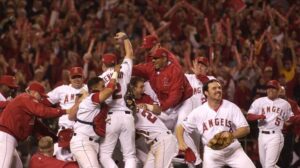
The Crown Jewel: The 2002 World Series Championship
The 2002 season is the bedrock of Angels lore. It wasn’t just a championship; it was a narrative masterpiece, a season that transformed a franchise from lovable underdogs into world champions and cemented the “Angels Baseball” brand into the national consciousness.
The “Rally Monkey” and the Road to the World Series
Under manager Mike Scioscia, the 2002 Angels were a resilient, contact-hitting team known for their relentless approach, aptly nicknamed “The Rally Monkey” for their never-say-die attitude. The team, which officially changed its name to the Los Angeles Angels of Anaheim a few years later, finished the regular season with a 99-63 record, securing the American League Wild Card.
Their path to the World Series was a gauntlet of heavyweight opponents:
-
ALDS vs. New York Yankees: The Angels announced their arrival by dethroning the four-time defending AL champions in four games, out-slugging the mighty Yankees and showcasing their explosive offense.
-
ALCS vs. Minnesota Twins: In a hard-fought series, the Angels defeated the Twins in five games, with Adam Kennedy’s three-home-run performance in the clinching Game 5 propelling them to the World Series for the first time since their inception in 1961.
Also read : The 100-Year Legacy Of University Of Miami Football: A Dynasty Built On Passion And Success
The 2002 World Series: Angels vs. San Francisco Giants
The stage was set for a classic California showdown: the Los Angeles Angels versus the San Francisco Giants. The Giants, led by the formidable slugger Barry Bonds, were the favorites. What followed was a seven-game series considered one of the most thrilling in baseball history.
-
Key Players: The Angels’ success was a testament to teamwork. While stars like Garret Anderson and Troy Glaus provided the power, it was the unsung heroes who shone brightest. Scott Spiezio’s game-tying three-run homer in Game 6 is the stuff of legend. Brendan Donnelly and Francisco Rodríguez (“K-Rod”) were nearly unhittable out of the bullpen. And of course, the series MVP, Troy Glaus, whose .385 average, three home runs, and eight RBIs were instrumental.
-
The Pivotal Game 6: With the Angels facing a 3-2 series deficit and a 5-0 hole in the 7th inning of Game 6, their season was on the brink. What happened next is etched in baseball folklore. The now-famous Rally Monkey appeared on the Jumbotron, and the Angels staged an improbable comeback, capped by Spiezio’s homer and a two-run, game-winning double by Garret Anderson. The 6-5 victory forced a Game 7 and broke the Giants’ spirit.
-
Game 7 and Championship Glory: Riding the tidal wave of momentum from Game 6, the Angels dominated Game 7. Rookie John Lackey pitched five strong innings, and the bullpen held firm. A two-run double from Garret Anderson in the third inning provided the crucial lead. When Troy Percival struck out Kenny Lofton for the final out, Angel Stadium erupted. The Los Angeles Angels were World Series champions for the first and only time in franchise history.
The 2002 World Series victory was more than a title; it was a cultural moment for Southern California baseball, proving that a team could emerge from the shadow of the Dodgers and capture the heart of a region.
The Long and Winding Road: Playoff Appearances and Near Misses
While 2002 remains the pinnacle, the Angels’ history is also a tapestry of “what ifs” and frustrating postseason exits. The franchise has struggled to recapture the magic of that magical run, despite fielding competitive teams and, at times, dominant regular-season squads.
The Glory Days of the 2000s
Following the 2002 championship, the Angels established themselves as a perennial power in the American League West under Mike Scioscia‘s leadership.
-
2004, 2005, 2007, 2008, 2009 AL West Champions: The Angels won five division titles in a six-year span. However, each postseason run ended in disappointment, often at the hands of the Boston Red Sox, who eliminated them in 2004, 2007, and 2008. The 2005 ALCS loss to the Chicago White Sox was another painful chapter. These teams, led by Vladimir Guerrero, John Lackey, and Francisco Rodríguez, were built for sustained success but couldn’t break through to another World Series.
The Mike Trout Era: A Paradox of Individual Brilliance and Team Struggle
The arrival of Mike Trout in 2011 marked a new era for the franchise. Trout is a generational talent, a lock for the Hall of Fame, and arguably the greatest all-around player of his generation. However, his career has been defined by a frustrating paradox: unparalleled individual success and consistent team failure.
Despite Trout’s three MVP awards and countless other accolades, the Angels have found sustained team success elusive. They have won only one playoff game (a 2014 ALDS sweep of the Kansas City Royals) during Trout’s tenure. Key factors for this disconnect include:
-
Lack of Pitching Depth: The Angels have consistently struggled to build a reliable, top-tier starting rotation and bullpen to complement their star-powered lineups.
-
Injuries to Key Players: Critical injuries to Trout himself, as well as other high-profile acquisitions, have repeatedly derailed promising seasons.
-
Underperforming Supporting Casts: Large contracts for players like Albert Pujols (though a beloved figure) and Josh Hamilton did not yield the expected production, hampering the team’s financial flexibility and on-field performance.
The Ohtani Phenomenon and Continued Quest
The signing of Shohei Ohtani in 2017 introduced a once-in-a-century talent to Anaheim. As a two-way phenomenon, Ohtani captured the imagination of the baseball world, winning the AL MVP award in 2021 and 2023. The pairing of Trout and Ohtani created one of the most formidable duos in sports history.
Yet, the result was the same. The Angels failed to reach the postseason a single time during Ohtani’s six-year tenure with the team. This period highlighted the immense difficulty of constructing a complete, 26-man roster capable of competing in a tough American League, even with two of the best players on the planet.
Beyond 2002: The Angels’ World Series History at a Glance
For a franchise with a rich history, the World Series appearances are, sadly, a short list.
| Year | Opponent | Result | Key Notes |
|---|---|---|---|
| 2002 | San Francisco Giants | Won, 4-3 | The franchise’s only championship. Iconic Rally Monkey, comeback in Game 6, Troy Glaus named MVP. |
| No Other Appearances | The Angels have not won the American League pennant since 2002. Their only other ALCS appearances were in 1979 (loss to Baltimore) and 1986 (loss to Boston). |
This table underscores the central narrative of the Angels: a long history with a single, shining moment of ultimate triumph.
The Future: Can the Angels Return to the World Series?
The question that haunts every Angels fan is, “When will we get back?” The path is challenging, especially following the departure of Shohei Ohtani in free agency after the 2023 season. The future now rests on several key pillars:
-
Health and Production of Mike Trout: The team’s cornerstone must remain healthy and return to his MVP-caliber form to anchor the lineup.
-
Strategic Team Building: Under new leadership, the front office must focus on developing a sustainable pipeline of young talent, particularly pitching, and making shrewd acquisitions to build a balanced, deep roster—a “team” rather than a collection of stars.
-
Navigating a Tough AL West: The division features powerhouses like the Houston Astros and Texas Rangers, as well as improving teams in Seattle and Oakland. The climb is steep.
The dream of another Angels World Series parade is very much alive. The memory of 2002 proves it is possible. The challenge is monumental, but in the world of baseball, hope is the currency of the offseason.
FAQs: Los Angeles Angels World Series
How many World Series have the Los Angeles Angels won?
The Los Angeles Angels have won one World Series championship in their franchise history, in 2002.
When was the last time the Angels were in the World Series?
The last and only time the Angels appeared in the World Series was in 2002, when they defeated the San Francisco Giants in seven games.
Have the Angels ever won a World Series at home?
Yes. The Angels clinched the 2002 World Series in Game 7 at their home stadium, then known as Edison International Field of Anaheim. The final out was recorded there, triggering a massive celebration.
What was the Angels’ name when they won the World Series?
When they won the World Series in 2002, the team was officially known as the Anaheim Angels. The name was changed from the California Angels before the 1997 season and then to the Los Angeles Angels of Anaheim after the 2004 season.
How many playoff appearances do the Angels have?
The Los Angeles Angels have made 10 playoff appearances in their history (1979, 1982, 1986, 2002, 2004, 2005, 2007, 2008, 2009, 2014). Their most successful appearance, of course, was the 2002 World Series victory.
The Enduring Legacy of 2002
The story of the Los Angeles Angels and the World Series is a tale of one glorious triumph standing tall against a backdrop of longing. The 2002 championship is not just a memory; it is the franchise’s North Star. It is the proof that under the right circumstances, with the right mix of talent, chemistry, and a little monkey magic, anything is possible.
For fans who witnessed it, 2002 is a sacred memory. For a new generation of fans, it is a legend passed down, a testament to what can be. As the Angels continue their quest to add a second chapter to their World Series history, the spirit of 2002—the resilience, the passion, the belief—remains the eternal standard. The dream of another parade down Katella Avenue continues to fuel the hope that defines being a baseball fan.