
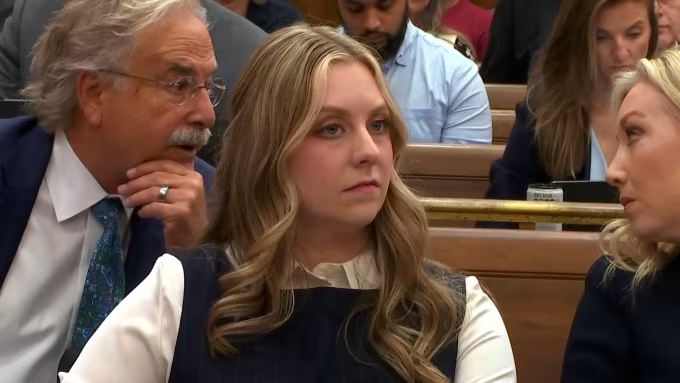
On January 6, 2023, a 6-year-old student at Richneck Elementary School in Newport News, Virginia, brought a firearm into class and shot his teacher, first-grader teacher Abby Zwerner, causing serious life-altering injuries.
This article delves specifically into the parental side of that case — the mother (and broader family) of the young shooter — their background, legal accountability, public statements, and what this incident reveals about broader themes of parenting, gun safety, and school responsibility.
Who are the parents (or guardians) in the case?
Mother: Deja Nicole Taylor
The key adult whose actions became central in the aftermath is the boy’s mother, Deja Nicole Taylor. Key facts:
- She legally purchased the firearm used in the incident (a 9 mm handgun) which her son brought to school and used to shoot Ms. Zwerner.
- She was indicted by a Virginia grand jury on a felony child neglect charge and a misdemeanor count of leaving a firearm accessible to a child.
- In addition, she faced federal charges (making false statements in gun purchase and unlawful possession while using marijuana) and pleaded guilty.
- In December 2023, she was sentenced in the state system to 2 years in prison for felony child neglect.
- In May 2023 she stated that her son has ADHD, and that she accepted responsibility because “he can’t take responsibility for himself.”
Other family/guardian context
There is mention of the boy’s grandfather or great-grandfather (depending on sources) in the broader guardianship and care arrangement after the incident. For example:
- The boy’s grandfather, Calvin Taylor, said the child was under his legal custody and was doing therapy and attending a different school.
- The family also described the boy as having an “acute disability” and being in a care plan that had included in-class parental support.
What happened regarding the parents’ responsibility and oversight?
This section reviews how parental (and household) oversight, gun storage, and background of the child came into focus.
Gun ownership and storage
- The gun was legally purchased by the mother.
- According to the family’s prior statements, the weapon was stored on a top shelf in the mother’s closet and was initially described as having a trigger lock.
- However, investigators found that the child retrieved the handgun by climbing a drawer to reach a top shelf where the mother’s purse held the firearm.
- The mother pled guilty in federal court to lying on a form when purchasing the firearm, concealing marijuana use.
Child’s behavioural and supervision context
- The child had a documented history of behavioural issues: according to the Wikipedia summary, including choking a teacher, locking arms around a teacher’s neck, and generally violent behaviour.
- The family and school described the child as having an “acute disability” (not fully defined publicly) and being under a care plan that originally included a parent present in class each day.
- The week of the shooting was reportedly the first week without a parent present in the classroom, per the mother’s remarks.
Legal responsibility and accountability
- Under Virginia law, a parent or guardian may be charged with felony child neglect if their omission in care is “gross, wanton, and culpable” showing reckless disregard for human life.
- The mother of the young shooter was thus charged under state law for child neglect and for leaving a loaded, unsecured firearm accessible to a child (the misdemeanor).
- Federally, she pleaded guilty to unlawfully obtaining and possessing a firearm and making false statements, which resulted in a sentence of 21 months in federal prison.
- In the civil realm, the teacher, Ms. Zwerner, filed a $40 million lawsuit against the school district and officials (not the parent), alleging administrators ignored warnings.
Public statements by the mother and family
From available reporting:
- In May 2023, Ms. Taylor gave an interview in which she said:
“I am, as a parent, obviously willing to take responsibility for him because he can’t take responsibility for himself.”
- She cited her son’s ADHD diagnosis and described him as “very energetic… doesn’t sit still, ever.”
- She also described her own mental-health issues: miscarriages, postpartum depression, hospitalisation.
- The child’s grandfather (or great-grandfather) expressed concern about the community negativity and said the boy was now receiving therapy and studying at another school.
What this reveals about parenting, gun safety & school oversight
The case opens up several major themes:
1. Gun Access and Parenting Responsibility
When a legally purchased firearm ends up in the hands of a small child, questions arise about storage, supervision, and parental responsibility. In this case, although the mother claimed trigger-lock storage and height placement, the child was still able to access it by climbing. That gap is at the core of the neglect charges.
Ensuring firearms are truly inaccessible to children is a major parenting and home-safety issue.
2. Child Behaviour Challenges and Supervision
The family disclosed that the boy had behavioural and attention-related diagnoses. The antecedent plan included a parent presence in class, which was changed in the week of the shooting. The absence of direct supervision coupled with known risk factors raises the question of whether more intensive oversight should have been in place.
3. Intersection of Parental Duty, Mental Health & Life Stress
The mother’s statements about postpartum depression, miscarriages, and mental-health concerns suggest a context of stress and vulnerability. This does not excuse neglect, but highlights that parental capacity can be influenced by mental-health and life-circumstance factors — and when those factors are present, risk for lapses in supervision may increase.
4. School Warnings and Shared Responsibility
While parenting and home storage were decisive, the case also underlines the multi-layered responsibility: the school had been warned multiple times that the child may have a gun. Thus, although the focus here is on the parent, it reminds us that parenting is one link in a chain of child-safety ecosystems (home + school + community).
5. Legal Precedent for Parent Exposure
The charges show that parents can be criminally liable when a child accesses a weapon and causes harm. The mother’s sentencing sends a signal: even if the child is extremely young (6 years old), adult supervision, firearm storage, and care plans still matter significantly.
Read too : The Age Juan Gabriel Died and Why His Legacy Still Lives On
Frequently Asked Questions (FAQ)
Q1: Was the father charged?
There is no widely reported criminal charge against the father in the publicly available sources at the time of writing. Most of the legal action has centered on the mother and school officials.
Q2: Did the mother intentionally and maliciously allow the gun to be used?
There is no indication in the public record that the mother intended for the shooting to occur. The charges stem from neglect (failure to properly secure the firearm and supervise the child), not premeditated facilitation of the crime.
Q3: What about the child’s disability or behavioural diagnosis — does that shift the parent’s responsibility?
While the child’s behavioural challenges and diagnoses (such as ADHD) are mentioned by the family, the legal responsibility rests on the adult’s duty of care. The court found (or alleged) that despite known risk factors and warnings, proper safeguards were not maintained. Thus, behavioural diagnosis does not absolve parental duty.
Q4: Are the parents of the teacher involved?
No. This article focuses on the parents of the young shooter, not of Ms. Zwerner. The teacher’s family has not been subject to public legal scrutiny in connection with the incident in the same way.
Q5: What happens next for the parent/spouse/family?
As of the latest publicly available information:
- The mother is serving a prison sentence (state + federal) in connection with the case.
- The boy is under alternate guardianship and receiving therapy according to the family.
- The civil lawsuit by the teacher against the school district and administrators is ongoing (school-side accountability).
Broader Takeaways for Parents & Families
- Secure firearms: If you own a gun and children are present in the home, the case underscores the absolute necessity of secure storage — trigger locks, locked cabinets, and highest inaccessible places may still be insufficient if a child is determined and unsupervised.
- Supervision matters: Especially in households where a child has behavioural or attention diagnosis, consistency of supervision, both at home and school, is critical.
- Open communication with schools: Parents should maintain strong collaboration with school staff when their child has known behavioural issues, ensuring that care‐plans are honoured (e.g., parent presence if required).
- Recognize parental capacity limits: Parental stress, mental-health issues, and life circumstances (like postpartum depression) can impair supervision. Seeking help and additional support is prudent.
- Shared responsibility: While parents are central, school systems and staff also have roles to play in recognising risks, acting on warnings, and coordinating with families. The case shows that failures at multiple levels combine to create tragedy.
Conclusion
The parents — particularly the mother, Deja Nicole Taylor — in the tragic incident involving teacher Abby Zwerner highlight how parental oversight (or lack thereof), gun-storage practices, child behavioural needs, and institutional factors intersect. While the mother accepted responsibility and faced criminal consequences for her omissions, the case serves as a stark reminder of how multiple failings (home, school, child supervision, gun safety) can converge.
For parents, educators, administrators and policymakers alike, the incident underscores the gravity and urgency of proactive, shared strategies to protect children, teachers, and communities from preventable tragedies.