
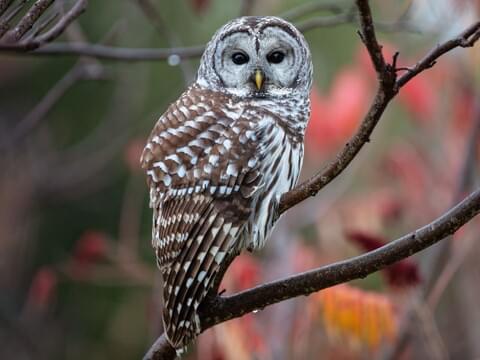
In the forests of western North America, one of the most significant wildlife-stories of the past decades involves two owl species: the Northern Spotted Owl (Strix occidentalis caurina) and the Barred Owl (Strix varia). This article provides a fully comprehensive overview of both species, how they differ, what is happening in their shared ecosystem, why this matters, and what conservation efforts are underway. Along the way we’ll cover identification, habitat, behaviour, threats, and the ecological drama between them.
May be you like : Iberian lynx (Lynx pardinus): Europe’s Comeback Wild Cat
What are the Spotted Owl and the Barred Owl?
Spotted Owl
The Northern Spotted Owl is a medium-sized forest owl native to old‐growth coniferous forests of the Pacific Northwest (and parts of British Columbia) in North America.
Its preferred habitat includes large, mature trees, closed canopies, complex forest structures and often riparian zones or moist, dense forest cover.
Because of habitat loss and other pressures, the Spotted Owl is considered threatened under the U.S. Endangered Species Act.
Barred Owl
The Barred Owl, in contrast, is native to the eastern part of North America (east of the Great Plains) but has gradually expanded its range westward.
It is larger, more adaptable, less specialized in habitat, and has become a powerful competitor where its range overlaps with the Spotted Owl.
Key Differences Between Spotted Owl and Barred Owl
Understanding how these two species differ helps explain why their interaction matters.
- Size & appearance: Barred Owls tend to be slightly larger and heavier than Spotted Owls.
- Plumage: The Spotted Owl has white spots on its head, back and breast; the Barred Owl has barred (horizontal) markings and streaks rather than distinct white spots.
- Bill & face colour: Barred Owls have a yellow-orange bill and somewhat paler face; Spotted Owl’s bill is more dull yellow and face darker.
- Habitat preferences: While both use mature forest, the Spotted Owl is more strictly tied to older forest structures, whereas the Barred Owl can tolerate more varied conditions.
- Ecological behaviour: Barred Owls have broader prey base (including day‐active prey), may require smaller territories, nest more successfully in overlapping zones.
Because of these differences, when Barred Owls move into Spotted Owl territory, the Spotted Owls often suffer competitive disadvantage.
Why the Co-existence is a Big Issue
Habitat overlap and competition
The root of the problem lies in the fact that Spotted Owls and Barred Owls share the same ecological niche when their ranges overlap. They occupy similar forest habitats, hunt similar prey, and nest in similar structures.
When Barred Owls invaded the West, they began to occupy territories that were formerly Spotted Owl strongholds—old growth forests, riparian zones, high canopy cover. Because Barred Owls require less territory for survival, and are more aggressive in competition, they out‐compete Spotted Owls.
Expansion of the Barred Owl range
Originally the Barred Owl’s range was limited to the eastern U.S., but due to changes in landscapes, fire suppression, and forest management, they found corridors to move west.
For example, Barred Owls were first reported in northern British Columbia in 1949, reached southern BC by 1959, Washington by 1969, Oregon by 1979 and north‐western California by 1985.
Impact on Spotted Owl populations
Because of the combined effect of habitat loss (logging, fragmentation) and direct competition from Barred Owls, Spotted Owl populations have been declining—despite decades of protection.
At many sites, Spotted Owls either abandon territories, reduce vocalizations (which affects mating), or suffer reduced reproduction because of Barred Owl pressure.
Identification and Field Marks
If you are a bird-watcher or naturalist, knowing how to distinguish the two owls is important.
Visual cues
- Spotted Owl: Round head (no ear tufts), brown overall, white spots on head/back/breast.
- Barred Owl: Similar shape (also no ear tufts), but has basally broader appearance, barred or streaked underside, yellow-orange bill, paler facial disc.
- Underparts: Spotted Owl shows white spots on breast/back; Barred Owl shows bars and streaks rather than discrete “spots”.
Vocalizations & behaviour
- Barred Owls are more vocal and territorial; their signature call sounds like “Who cooks for you? Who cooks for you all?” (though that mnemonic is somewhat simplistic).
- Spotted Owls have softer, less numerous vocalizations and are often more secretive once displaced.
Habitat & perching
If you find an owl in deep, undisturbed old growth forest with high canopy and large trees, you might suspect Spotted Owl. If the habitat is more generalized, secondary growth or mixed forest and you spot a large owl with yellowish bill in the west, it could well be a Barred Owl.
Ecology, Behavior and Life History
Spotted Owl ecology
- Diet: Mainly small mammals like flying squirrels, woodrats, and other arboreal rodents, also occasionally birds.
- Nesting: Use large old trees, tree cavities, broken tops, snags; rely on older forest structures.
- Territory: Require large areas of high-quality forest; limited alternative habitats.
- Reproduction: Often one brood per year; fewer young compared to more opportunistic species.
Barred Owl ecology
- Diet: More generalist: rodents, birds, amphibians, reptiles, even invertebrates; some daytime prey.
- Nesting: Also use tree cavities or large trees but are less specialized; can use slightly less pristine habitats.
- Territory: Can survive with smaller territories in some contexts, thus can aggregate more densely and out‐compete Spotted Owls.
- Reproduction: More frequent, more successful; thus greater competitive edge.
Conservation Status & Threats
Spotted Owl
- Listed as threatened under the U.S. Endangered Species Act (ESA).
- Major threats: old‐growth forest logging, habitat fragmentation, climate change altering forest composition, and now competition from Barred Owls.
- Because habitat recovery is slow (old growth takes decades or centuries), population recovery is difficult.
Barred Owl
- Globally, the Barred Owl is listed as Least Concern.
- In western regions, however, it is considered invasive or a “threat” where it overlaps with Spotted Owls, because it alters ecological balance.
The Controversial Conservation Dilemma
One of the most striking features of this story is the ethical and practical difficulty of conservation: to protect a threatened species (Spotted Owl), management agencies have considered reducing Barred Owl numbers—effectively culling one species to help another.
For example, a recent program proposes removing up to 450,000 Barred Owls across Washington, Oregon and California over 30 years to support the Spotted Owl. The ethical debate is intense: can we justify killing one (relatively healthy) species to save another? Some argue yes, given habitat destruction is largely human‐caused; others argue that culling is ethically fraught.
What Can Be Done: Conservation Efforts and Strategies
Habitat protection and restoration
For the Spotted Owl, restoring and protecting old-growth forest is critical. This means limiting logging, preserving large contiguous forest stands, maintaining canopy cover, and restoring ecosystems that were historically logged or burned.
It also means addressing climate change effects on forest health (drought, wildfire, pathogen) which further threaten suitable habitat.
Managing Barred Owl competition
Several strategies are used or proposed:
- Monitoring: Track where Barred Owls are overlapping Spotted Owl territories.
- Removal/Culling: In places where Barred Owl presence is very high and Spotted Owls are declining, selective removal has shown some positive effect. For instance, in trial studies where Barred Owls were removed, Spotted Owl occurrence and reproduction stabilized.
- Non‐lethal management: Some propose exploring fertility control or other less lethal methods, though these may be less proven.
- Adaptive management: Recognize that the situation is dynamic and requires monitoring, research, and flexibility.
Public awareness and policy
Educating the public about the complexity of species interactions helps build support for conservation policies. Land-use decisions, logging policy, forest management and funding for long-term ecological research all play a part.
Why This Story Matters
Here are several reasons why the Spotted Owl / Barred Owl issue is far more than just a bird-watching topic:
- Indicator species for old-growth forests: The Spotted Owl signals the health of old‐growth forest ecosystems. Their decline points to broader ecosystem problems.
- Human‐caused ecological change: The Barred Owl’s range shift was facilitated by human land‐use changes (fire suppression, forest fragmentation, altered landscapes) which allowed them to move west.
- Complexity of conservation: Shows how protecting one species may require managing another, and how conservation isn’t always simply “restore habitat and species bounce back.” Inter-species interactions matter.
- Ethical considerations: The question of whether humans should intervene by killing one native species to save another raises moral and philosophical questions in wildlife management.
- Long-term ecosystem implications: The decline of Spotted Owls also affects prey species, forest structure, fire regimes, and overall biodiversity of these old‐growth systems.
Frequently Asked Questions (FAQ)
Q: Can Spotted Owls and Barred Owls interbreed?
Yes — there is documented hybridisation (“sparred owls”) where the two species overlap. These hybrids complicate conservation and genetic purity concerns.
Q: Are Barred Owls “invasive”?
They are native to North America, but in the western forests they are non‐historical and thus sometimes considered “functionally invasive” because they are encroaching into habitat of another species and displacing it.
Q: What is the biggest threat to the Spotted Owl?
Although competition from Barred Owls is serious, habitat loss remains a core threat. Even without Barred Owls, the loss of old‐growth forests would still be devastating for Spotted Owls.
Q: Does culling Barred Owls really help Spotted Owls recover?
Studies show positive effects where Barred Owls were removed: Spotted Owl occurrence and reproduction stabilized in those zones. However, removal alone is not sufficient without habitat restoration and broader management.
Q: How can bird-watchers help?
- Report sightings of both species to local wildlife or birding organisations;
- Support policies that protect old‐growth forests;
- Avoid disturbing nesting sites and be respectful of forest habitat;
- Educate others about the complexity of forest ecosystems and interspecies competition.
The Future: Outlook and Challenges
The future for the Spotted Owl remains uncertain. Without rapid, effective habitat restoration and meaningful competition management, their decline may continue. The Barred Owl invasion isn’t going away quickly—they are resilient, adaptable, and have multiple advantages.
On the other hand, conservation agencies are developing more intensive strategies, combining habitat protection with competition mitigation. But these efforts are expensive, long‐term and face ethical, logistical and funding hurdles.
Climate change further complicates matters: more frequent wildfires, pest outbreaks, droughts and shifts in forest composition all make old‐growth preservation harder and may favour the more adaptable Barred Owl.
In short: this is a race between restoration and degradation; between the specialized species (Spotted Owl) and the generalist/hardy competitor (Barred Owl).
Summary & Key Takeaways
- The Spotted Owl and Barred Owl share habitat and ecological niche in certain forest regions—leading to direct competition.
- Barred Owls have broad advantages (adaptability, broader prey base, smaller territory needs) that allow them to out‐compete Spotted Owls in overlapping zones.
- The Spotted Owl’s decline is driven by both habitat loss and competition from Barred Owls.
- Conservation strategies must tackle not just habitat, but also interspecies dynamics and sometimes difficult management decisions (even culling).
- The story is emblematic of larger conservation themes: human-caused change, the complexity of ecosystems, ethical dilemmas, and the urgency of protecting old-growth forest ecosystems.
Call to Action
If you care about forest ecosystems, biodiversity, and the fate of iconic species like the Spotted Owl, here are some actions you can consider:
- Advocate for policies that protect old‐growth forests and reduce logging in sensitive habitats.
- Support or donate to organisations working on owl monitoring, forest restoration, and wildlife conservation in the Pacific Northwest.
- Educate others: share this topic with friends, local groups, schools—highlight how species competition and habitat change intertwine.
- Participate in citizen science: many birding organisations ask for sightings, data logs, and reports that help scientists track these species.
- Respect habitats: when you go into forests, use established trails, avoid disturbing nesting sites, minimize noise and leave no litter.
Final Thoughts
The narrative of the Spotted Owl and the Barred Owl is more than just a tale of two birds. It’s a microcosm of the challenges facing conservation in the 21st century: how to protect a specialized species in a changing world, how to deal with unintended consequences of past land‐management, how to balance competing species’ rights, and how to act ethically and effectively.
If we succeed in helping the Spotted Owl, we help preserve an entire ecosystem of old‐growth forest, a legacy of biodiversity, and a symbol of wilderness. If we fail, we risk losing not only a species but the complex web of life that old forests support.
By paying attention, by supporting conservation efforts, and by understanding the deeper dynamics at play, we can hope to tip the balance in favour of these majestic owls and the forests they call home.